As a seasoned technician with over a decade of hands-on experience in the intricate world of scroll saws, I’ve had the privilege of working with and evaluating countless models, from beginner-friendly options to high-end professional machines. The choice between a scroll saw and a band saw often sparks a lively debate among crafters and woodworkers. Both are formidable tools, but they cater to distinctly different needs and project types. This article will meticulously dissect the capabilities of each, helping you navigate their unique features to determine which saw will best empower your crafting ambitions in 2026 and beyond.
Understanding the Scroll Saw
A scroll saw is often considered the artist’s precision instrument in the workshop. It’s a small, motorized saw designed specifically for intricate cuts, delicate designs, and detailed work on various materials. Its ability to create tight curves and internal cuts makes it indispensable for many craft projects.
Definition and Applications for Crafts
|
Our Picks for the Best Scroll Saw in 2026
As an Amazon Associate I earn from qualifying purchases.
|
||
| Num | Product | Action |
|---|---|---|
| 1 | Scroll Saw Workbook, 3rd Edition: Learn to Master Your Scroll Saw in 25 Skill-Building Chapters (Fox Chapel Publishing) Ultimate Beginner's Guide with Projects to Hone Your Scrolling Skills |

|
| 2 | 3D Scroll Saw Projects: 35 Fun Compound-Cut Projects, More Than 150 Patterns (Fox Chapel Publishing) Scroll Saw Woodworking & Crafts Magazine Compilation - Ornaments, Home Décor, Chess Set, and More |
|
| 3 | 2025 Scroll saw patterns: Scroll saw patterns: Inspirations for wood lovers: 164 patterns with Trees of Life, Hearts, Sailboats, animal family puzzles, landscapes... |
|
| 4 | WEN Adjustable Scroll Saw Stand for all WEN and DeWALT® Scroll Saws (MSA1621) |
|
| 5 | Scrolling 101: Everything the Beginner Needs to Know (Fox Chapel Publishing) Scroll Saw Basics, Choosing Blades, Adapting Patterns, Using a Starter Saw, Sanding, and a Skill-Building Exercise Pattern |
|
| 6 | Shop Fox W1872 16" VS Scroll Saw with Foot Switch, LED, Miter Gauge, Rotary Shaft |
|
| 7 | FOXBC 5-Inch Scroll Saw Blade Pin End Replacement for Wen 3921 3923, Dremel, Craftsman, Penn State, Delta, Ryobi and All 15in.and 16in.Scroll Saw For Wood, High Carbon Steel - 48 Pack |
|
| 8 | BLACK+DECKER Jig Saw, 4.5 -Amp (BDEJS300C) |
|
| 9 | Big Book of Scroll Saw Woodworking: More Than 60 Projects and Techniques for Fretwork, Intarsia, and Other Scroll Saw Crafts (Fox Chapel Publishing) Patterns for Beginners to Advanced Woodworkers |
|
| 10 | Making Wooden People & Pets with Personality: 24 Easy Projects for the Scroll Saw (Fox Chapel Publishing) Full-Size Patterns for Beginners and Intermediate Scrollers to Create Handmade Gifts in Wood |
|
At its core, a scroll saw utilizes a thin, reciprocating blade that moves rapidly up and down, much like a sewing machine needle. This controlled vertical motion allows for exceptional precision, enabling crafters to guide their workpiece with remarkable accuracy. Scroll saws excel at intricate fretwork, custom inlays, wooden puzzles, decorative ornaments, and detailed cabinetry accents. They are ideal for projects requiring fine detail and complex patterns where a delicate touch is paramount. Many prefer scroll saws for crafting wooden toys and personalized signs due to their ability to produce smooth, clean edges that often require minimal sanding. This versatility extends beyond wood to thin plastics, plexiglass, shell, bone, brass, and even thin sheets of glass with specialized blades.
Types of Scroll Saws
Scroll saws primarily differentiate by their arm design and throat capacity, which directly impacts the size of material they can handle.
- Parallel Arm Scroll Saws: This is the most common design, featuring two arms that run parallel to each other, with the blade attached to their ends. The motor is typically located at the back, driving the arms in an up-and-down motion. They are known for their balance of performance and vibration reduction, making them a popular choice for many crafters.
- Double Parallel Link Arm Scroll Saws: Considered a more advanced design, these saws feature rods in the upper and lower arms that are “pushed” by the motor. This mechanism moves shorter, articulated arms that hold the blade, leading to significantly reduced vibration and smoother operation. Brands like DeWalt and Excalibur often utilize this design, setting a high standard for precision.
- C-Arm Scroll Saws: Characterized by a solid C-shaped arm, with the blade mounted between the two ends, this design typically has one pivot point. While some older or more budget-friendly models might feature a C-arm, they generally produce a more aggressive, arcing cut and may exhibit more vibration.
- Benchtop vs. Floor-Standing: Most scroll saws are benchtop models, designed to sit on a workbench. They are relatively compact and suitable for small workshops. While truly “floor-standing” scroll saws are rare, larger benchtop models with optional stands provide a more permanent setup.
Components and How They Work
Understanding the scroll saw’s anatomy clarifies its function.
- Blade: The heart of the scroll saw. Blades are typically 5 inches long, available in various tooth patterns (skip tooth, double skip tooth, spiral, reverse tooth) and sizes, ranging from incredibly fine for jewelry (#10/0) to larger for general woodworking. They come in pinned and pinless (plain-end) varieties, with pinless blades offering more precision and easier internal cuts.
- Upper and Lower Arms: These arms hold and tension the blade, driven by the motor to create the reciprocating motion.
- Table: A flat surface where the workpiece rests, often capable of tilting up to 45 degrees for angled or bevel cuts.
- Motor: Provides the power for the blade’s up-and-down movement. Many modern scroll saws feature variable speed control, allowing adjustment of strokes per minute (SPM) to match the material and desired cut.
- Blade Clamps: Securely hold the blade at both ends. Tool-less blade clamps are a popular feature for quick blade changes, especially for interior cuts.
- Tensioning Mechanism: A knob or lever, usually at the back or front, used to adjust blade tension. Correct tension is crucial for straight cuts and preventing blade breakage.
- Dust Blower/Port: Many models include a flexible air hose or blower to clear sawdust from the cutting line, enhancing visibility. Some also have dust collection ports for vacuum attachment.
- Hold-Down Foot: A small foot that presses lightly on the workpiece, preventing it from lifting with the blade’s upward stroke, ensuring cleaner cuts.
The scroll saw operates by the motor driving the arms, which in turn move the blade up and down. As you guide the material against the blade, the teeth cut through it. The ability to easily remove and re-attach the blade through a pre-drilled hole in the workpiece is unique to the scroll saw, allowing for intricate internal cutouts without needing an entry slot from the edge.
 A close-up view of a crafter's hands guiding a delicate wooden piece through a scroll saw blade to create intricate fretwork, with sawdust gently blowing away, bright workshop lighting, realistic style
Understanding the Band Saw
In contrast to the scroll saw’s delicate touch, the band saw is often regarded as the workhorse of the workshop, designed for powerful, continuous cutting through thicker and larger materials. While it can make curves, its strength lies in efficiency and capacity.
Definition and Applications for Crafts
A band saw employs a long, continuous loop of toothed metal (the blade) stretched tightly between two or more rotating wheels. This continuous, one-directional motion allows the band saw to slice through substantial materials with ease and speed. For crafters, band saws are invaluable for tasks that require breaking down lumber, resawing (cutting thicker boards into thinner ones), creating cabinet legs, cutting larger curved shapes, and producing blanks for turning or carving. They are also suitable for cutting various materials including wood, metal, and plastics, making them highly versatile for projects like furniture making, large-scale wood sculpting, and creating robust templates. While generally leaving a slightly coarser edge than a scroll saw, their accuracy and capacity for thicker stock are undeniable.
Types of Band Saws
Band saws come in several configurations, primarily categorized by their orientation and size.
- Vertical Band Saws: These are the most common type for woodworking and crafting, with the blade running vertically. The workpiece is guided manually across a table into the blade. They are excellent for cutting curves and irregular shapes, and with the right blade, can even resaw lumber.
- Horizontal Band Saws: Primarily used in metalworking, these saws hold the workpiece stationary while the blade swings down horizontally to cut it to length. Less common for intricate crafting with wood.
- Benchtop Band Saws: Compact and designed for smaller workshops or hobbyists, these models sit on a workbench. They have smaller motors and cutting capacities compared to their floor-standing counterparts, ideal for lighter-duty tasks and materials up to a few inches thick.
- Floor-Standing Band Saws: Larger and more powerful, these saws are freestanding units suitable for professional workshops or serious DIYers with ample space. They offer higher horsepower motors, greater cutting capacities (often 6+ inches of resaw capacity), and are built for heavy-duty, prolonged use.
Components and How They Work
The design of a band saw, though different from a scroll saw, also features key components working in concert.
- Blade: A continuous loop of metal with teeth, available in various widths, tooth patterns (regular, skip tooth, hook tooth, variable pitch), and materials (carbon steel, bi-metal) to suit different tasks and materials. Narrower blades allow for tighter curves, while wider blades are best for straight cuts and resawing.
- Wheels: Typically two (an upper and a lower), these wheels tension and drive the continuous blade. The lower wheel is usually powered by the motor, while the upper wheel is an idler that can be adjusted for blade tension and tracking.
- Motor: Powers the drive wheel, dictating the saw’s ability to cut through different material thicknesses and densities. Motor power typically ranges from 1/4 HP for light-duty benchtop models to 3 HP or more for heavy-duty floor-standing units.
- Table: A flat surface, usually cast iron, where the material rests. Most tables can tilt for angled cuts.
- Blade Guides: Located above and below the table, these guides (often consisting of side blocks/bearings and a thrust bearing) support the blade, preventing it from twisting or drifting during a cut. Proper adjustment is critical for accuracy and blade longevity.
- Tensioning Mechanism: A control, often a handwheel, that adjusts the tension of the blade between the wheels. Correct tension is vital for straight cuts and preventing blade breakage.
- Dust Port: Band saws typically have a dust collection port to connect to a shop vacuum, managing the significant amount of sawdust they produce.
The band saw’s working principle involves the motor continuously rotating the blade around the wheels. As the material is fed into the blade, the continuous cutting action efficiently slices through it. Unlike a scroll saw, a band saw cannot make internal cuts without an entry slot from the edge, due to its looped blade design.
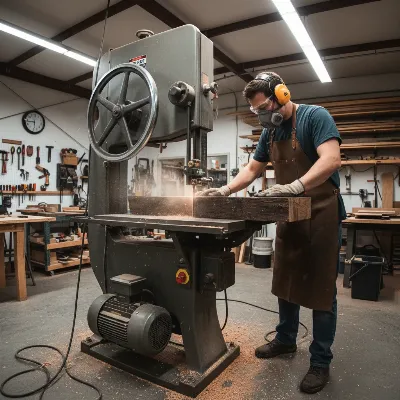 A crafter using a band saw to cut a large, thick piece of wood for a furniture component, demonstrating powerful, swift action, with good lighting, realistic style
Scroll Saw vs. Band Saw: A Detailed Comparison for Crafters
When choosing between a scroll saw and a band saw for crafting, the decision often hinges on the specific demands of your projects. Both have their strengths and weaknesses.
| Feature | Scroll Saw | Band Saw |
|---|---|---|
| Blade Type | Thin, reciprocating (up/down motion) | Continuous loop, one-directional motion |
| Primary Use | Intricate cuts, delicate designs, internal cuts | Resawing, ripping, large curves, thick materials |
| Precision | Very high for fine detail, tight curves, fretwork | Moderate for curves, high for straight cuts in thick stock |
| Material Thickness | Best for thin materials (< 2 inches, typically < 1 inch for detail) | Excellent for thick materials (6+ inches, depending on saw) |
| Internal Cuts | Yes, blade can be threaded through drilled holes | No, requires an entry cut from the edge |
| Cut Finish | Very smooth, often requires minimal sanding | Slightly coarser, usually needs more sanding |
| Speed | Slower, controlled strokes (400-1750 SPM) | Faster, continuous cut (1520-3060 SFPM) |
| Noise | Generally quieter | Louder, especially with larger models |
| Vibration | Minimal, especially with double parallel link arms | Can be significant if not properly tuned or heavy-duty |
| Safety | Generally considered safer for intricate work | Higher risk due to continuous, powerful blade |
| Footprint | Compact, benchtop-friendly | Larger, often floor-standing, requires more space |
| Cost | Generally more affordable | More expensive, especially larger models |
Precision and Intricacy
For projects demanding ultimate precision and intricate detail, the scroll saw is the undisputed champion. Its thin, fine blades allow for extremely tight turns and delicate patterns that a band saw simply cannot replicate. The reciprocating motion provides meticulous control, making it perfect for detailed fretwork, intarsia, marquetry, and small decorative pieces.
A band saw, while capable of cutting curves, cannot achieve the same level of intricacy. The wider blades, even the narrowest available for band saws, limit the tightness of the curves and make detailed internal cuts impossible. Its strength lies in smooth, consistent curves on larger pieces, rather than minute details.
Cutting Capacity and Speed
The band saw excels in cutting capacity and speed. If your projects involve processing thicker lumber, resawing large boards into thinner veneers, or making fast, long cuts, a band saw is the superior choice. It can comfortably handle materials several inches thick, with some models boasting resaw capacities of over a foot. The continuous blade motion ensures a faster, more aggressive cut through dense materials.
Conversely, scroll saws are designed for thinner stock, typically up to 2 inches, though detailed work is most comfortable on materials less than 1 inch thick. Attempting to cut very thick materials with a scroll saw can lead to excessive blade heat, premature dulling, blade drift, and frequent breakage. The cutting speed is much slower, prioritizing control over rapidity.
Blade Types and Versatility
Both saws offer a range of blade types, but their versatility differs. Scroll saw blades come in myriad tooth configurations and sizes (pinned/pinless, spiral, skip-tooth, reverse-tooth) to handle extreme detail in various materials. The ability to easily change blades for different tasks and thread them through pilot holes for internal cuts is a key advantage.
Band saw blades also vary in width, tooth pattern (hook, skip, regular), and material (carbon steel, bi-metal) to cut different woods, metals, and plastics. Wider blades offer stability for straight cuts and resawing, while narrower blades allow for broader curves. However, the continuous loop design restricts internal cuts and limits the minimum radius of curves compared to a scroll saw.
Safety Considerations
Scroll saws are generally considered safer than band saws, making them a popular choice for beginners and even supervised younger users. The small, reciprocating blade means that accidental contact typically results in a minor cut rather than a severe injury. The blade stops almost instantly if broken, and kickback is minimal.
Band saws, with their powerful, continuously moving blades, pose a higher risk. Kickback can be more significant, and blade breaks can be dangerous if the blade escapes the guards. Proper guarding, correct blade tension, and careful feeding are crucial for safe operation. Always wear appropriate personal protective equipment (PPE), including safety glasses and hearing protection, with both tools.
Noise and Vibration
Scroll saws are notably quieter than band saws. Their electric motors operate at lower speeds, resulting in less noise, making them more suitable for home workshops or shared spaces where noise pollution is a concern. Modern scroll saws, especially those with double parallel link arms, are designed to minimize vibration, contributing to more accurate cuts and reduced user fatigue.
Band saws, particularly larger models with powerful motors, can be quite noisy. They also tend to produce more vibration, which can affect cut quality and user comfort over long periods. A sturdy, heavy frame helps to mitigate vibration, but it’s an inherent characteristic of the tool’s continuous operation.
Cost and Maintenance
Scroll saws are generally more affordable than band saws, especially when comparing entry-level models. This makes them a more accessible investment for hobbyists or those on a tighter budget. However, scroll saw blades are typically more fragile and can break more frequently, especially during learning, adding to ongoing costs.
Band saws represent a more significant initial investment. While their blades are more robust, proper maintenance, including tensioning, tracking, and guide adjustment, is critical for blade longevity and optimal performance. Both tools require regular cleaning, lubrication of moving parts, and ensuring all safety features are operational.
Top Scroll Saw and Band Saw Brands for Crafting
Several reputable brands consistently produce high-quality scroll saws and band saws suitable for crafters.
For Scroll Saws, some of the most highly regarded brands in 2026 include:
- DeWalt: The DW788 is consistently ranked as a top choice for its double parallel link arm design, significantly reducing vibration and offering exceptional precision.
- Delta: Known for durable models like the Delta 40-694, which provides robust performance and features like an upper arm that lifts for easy blade changes.
- WEN: Offers excellent value with models like the WEN 3921 (16-inch) and WEN LL2156 (21-inch), often praised for ease of use and affordability, making them great for beginners and intermediate users.
- Jet: Provides professional-grade options such as the JWSS-22B, known for durability and advanced features like electronic variable speed control.
- Shop Fox: The W1713 is a popular choice for its blend of features and compact design, accommodating both plain and pin-end blades.
- Grizzly Industrial: Offers several models, including 18-inch and 21-inch saws, which are well-regarded for their power and features suitable for more experienced users.
For Band Saws often used by crafters and hobbyists, brands to consider in 2026 include:
- JET: Brands like the JET JWBS-14SFX are frequently cited for their professional-grade quality, heavy-duty frames, and re-sawing capabilities, making them excellent for serious hobbyists.
- Rikon: A respected name for woodworking band saws, offering models known for precision and solid construction.
- Delta: Similar to scroll saws, Delta produces reliable band saws that cater to both hobbyist and professional needs.
- WEN: Provides affordable benchtop band saws that are popular among beginners and DIY enthusiasts for their compact size and versatility.
- Skil: Offers benchtop models suitable for light-duty applications and smaller workshops.
- Milwaukee and DeWalt (Portable/Compact): While often geared towards metalworking or job sites, their portable band saws (e.g., DeWalt DCS371, Milwaukee M18FBS85-0C) can be useful for quickly cutting smaller, thicker craft materials like pipes or specific metal components where a full-size band saw isn’t practical or needed.
Choosing a brand often comes down to balancing budget, desired features, and the specific types of projects you undertake.
Choosing the Right Tool for Your Craft Projects (Buying Guide)
Deciding between a scroll saw and a band saw, or even choosing a specific model, involves evaluating your crafting needs against the tool’s capabilities.
Factors to Consider When Selecting a Saw
- Project Type and Intricacy: For delicate fretwork, intricate puzzles, detailed inlays, or projects requiring internal cutouts, a scroll saw is essential. If your projects involve larger curves, resawing thick lumber, or quick breakdown cuts, a band saw is more suitable.
- Material Thickness: Scroll saws excel on thin materials (up to 1-2 inches). Band saws are built for thicker stock (multiple inches or more).
- Workshop Space: Scroll saws are compact and benchtop-friendly. Band saws, especially floor-standing models, require significantly more space. Benchtop band saws offer a compromise for smaller workshops.
- Budget: Scroll saws are generally a lower initial investment. Factor in blade costs; scroll saw blades can break more frequently.
- Variable Speed Control: Highly recommended for both tools (especially scroll saws) to match the blade speed to the material and complexity of the cut, preventing burning or splintering.
- Blade Changing Mechanism: Look for tool-free or quick-release blade clamps, especially on scroll saws, as blade changes are frequent for internal cuts.
- Dust Management: A good dust blower (scroll saw) or dust collection port (both) is crucial for visibility and workshop cleanliness.
- Vibration Reduction: Essential for precision and comfort, particularly with scroll saws. Double parallel link arm designs are excellent for this.
- Table Tilt: A tilting table (or tilting arm on some scroll saws) allows for angled cuts, expanding project possibilities.
- Throat Capacity: For scroll saws, this measures the distance from the blade to the back of the frame, determining the maximum width of a workpiece you can cut. For band saws, it affects both width and resaw height.
Scroll Saw for Beginners
For newcomers to woodworking and crafting, a scroll saw is often the recommended starting point due to its relative safety, ease of control, and immediate ability to create visually appealing intricate projects. Look for models with:
- Variable speed control: This allows you to slow down for tricky cuts and delicate materials.
- Tool-free blade changes: Simplifies the process of setting up for internal cuts.
- Adequate throat depth (e.g., 16-20 inches): Provides versatility for various project sizes.
- Minimal vibration: Enhances control and comfort, reducing frustration.
Models like the WEN 3921 or entry-level DeWalt DW788 offer a great balance of features and user-friendliness for beginners.
Scroll Saw or Band Saw for Advanced Crafters and Professionals
Experienced crafters and professionals might consider owning both, as they are complementary tools. However, if choosing one, prioritize based on your most frequent projects.
- For highly detailed, artistic work (fretwork, intarsia, small intricate pieces): A high-quality scroll saw (e.g., DeWalt DW788, Jet JWSS-22B) with excellent vibration dampening, precise blade tension control, and quick blade changes is paramount.
- For larger-scale projects (furniture components, resawing, large templates, thick stock): A robust floor-standing band saw (e.g., from JET, Rikon) with a powerful motor (1.5 HP+), significant resaw capacity, and accurate blade guides is a better investment. Consider models with a large, stable table and efficient dust collection.
> “The ideal crafting workshop often includes both a scroll saw for its artistic precision and a band saw for its robust capacity. They’re not replacements, but partners in creation.”
Maximizing Your Crafting Potential: Usage and Maintenance Tips
Proper usage and consistent maintenance are key to the longevity and performance of both your scroll saw and band saw, ensuring safe and satisfying crafting experiences.
Scroll Saw Usage & Maintenance
- Blade Selection: Always choose the correct blade type and size for your material and cut. Finer blades for thinner materials and intricate cuts, coarser blades for thicker materials.
- Blade Tension: Correct tension is vital. Too loose, and the blade drifts or breaks; too tight, and it snaps. Adjust according to blade type and material thickness. Many experienced scrollers suggest adjusting tension until the blade produces a clear “ping” when plucked.
- Speed Control: Adjust your SPM. Slower speeds for hard materials, intricate cuts, or plastics (to prevent melting). Faster speeds for softwoods and general cutting.
- Feed Rate: Do not force the workpiece into the blade. Let the blade do the cutting. A moderate, steady feed rate prevents burning, blade deflection, and breakage.
- Internal Cuts: For internal cuts, drill a pilot hole, detach the blade from the top or bottom clamp, thread it through the hole, and re-clamp it before tensioning.
- Cleanliness: After each session, vacuum sawdust from the table and around the blade clamps. Release blade tension when not in use to prolong blade and saw life.
- Lubrication: Periodically lubricate moving parts as recommended by the manufacturer. Keep the table surface waxed or lubricated to allow the workpiece to slide smoothly.
Band Saw Usage & Maintenance
- Blade Selection: Match the blade width and tooth pattern to your task. Narrower blades (1/8-1/4 inch) for tighter curves, wider blades (1/2-1 inch) for resawing and straight cuts. Fewer teeth for wood, more teeth for metal or plastics.
- Blade Tension and Tracking: Proper tension is critical for straight cuts. Adjust the upper wheel to ensure the blade tracks correctly on the center of the wheels. Misalignment is a common cause of crooked cuts and blade breaks.
- Blade Guides: Adjust the blade guides (side blocks/bearings and thrust bearing) to be just barely touching the blade, providing support without causing friction or overheating. The thrust bearing should be set slightly behind the blade teeth.
- Resaw Fence: When resawing, use a dedicated resaw fence or a tall auxiliary fence to ensure the material stays perpendicular to the table.
- Dust Collection: Always connect your band saw to an efficient dust collection system, as it generates a large volume of sawdust.
- Cleaning: Regularly clean sawdust and debris from inside the cabinet, especially around the wheels and blade guides, to prevent buildup and maintain proper tracking.
- Wheel Tires: Inspect the rubber tires on the wheels periodically. They should have a slight crown to help the blade track correctly. Worn or damaged tires need replacement.
Safety First for Both Tools
Regardless of which saw you operate, safety must always be your top priority.
- Personal Protective Equipment (PPE): Always wear safety glasses or a face shield. Hearing protection is recommended, especially for band saws.
- Work Area: Keep your workspace clear of clutter, debris, and sawdust. Ensure good, even lighting.
- Clothing and Hair: Secure loose clothing, jewelry, and tie back long hair to prevent them from getting caught in moving parts.
- Power Disconnection: Always disconnect the power before performing any adjustments, maintenance, or blade changes.
- Hold-Downs and Jigs: Use hold-down devices and appropriate jigs to secure small workpieces and keep your hands away from the blade. Never cut freehand in mid-air.
- Inspect Workpiece: Ensure there are no nails, screws, or foreign objects in the material before cutting.
- Listen to Your Saw: If the saw makes unusual noises or vibrates excessively, stop immediately, turn it off, and diagnose the problem before continuing.
- Never Force the Cut: Let the blade cut at its own pace. Forcing the material can lead to kickback, blade deflection, or injury.
Common Issues and Troubleshooting When Using Scroll Saws and Band Saws
Even with proper usage and maintenance, you might encounter issues. Knowing how to troubleshoot common problems can save time and frustration.
Scroll Saw Common Issues
- Blade Breakage: This is often due to incorrect blade tension (too tight or too loose), forcing the cut, using the wrong blade for the material, or making sharp turns with a blade too wide. Adjust tension, slow your feed rate, and use finer blades for intricate curves.
- Crooked Cuts/Blade Drift: Primarily caused by improper blade tension, a dull or damaged blade, or applying uneven pressure to the workpiece. Check blade tension, replace dull blades, and ensure an even feed.
- Burning Wood: Occurs when the blade dulls, the feed rate is too slow, or the blade speed is too high for the material. Use a sharp blade, increase feed rate slightly, or reduce blade speed.
- Splintering on Bottom Edge: Often reduced by using a reverse-tooth blade or taping the bottom of the workpiece. Ensure the hold-down foot is properly adjusted.
- Excessive Vibration: Can be a sign of an unbalanced blade, loose components, or a saw not securely mounted. Check all fastenings and ensure the saw is on a stable surface.
Band Saw Common Issues
- Blade Drifting/Crooked Cuts: The most common band saw problem. Causes include insufficient blade tension, dull blade, improperly adjusted blade guides, incorrect blade width for the curve, or feeding too fast. Check tension, replace/sharpen blades, adjust guides, and use a narrower blade for tighter curves.
- Blade Breaks: Can result from improper tension (too tight), incorrect blade tracking, worn wheel tires, or hitting an obstruction. Ensure proper tension, check wheel alignment, and inspect tires.
- Burning Wood/Excessive Heat: Indicates a dull blade, too slow a feed rate, or insufficient gullet capacity for chip clearance. Use a sharp blade, adjust feed rate, and ensure the blade teeth are clearing chips effectively.
- Vibration and Noise: May signal worn bearings, an unbalanced blade, loose components, or an unstable stand. Inspect bearings, check blade for damage, and tighten all parts.
- Uneven Cuts or Resawing: Usually points to incorrect blade tension, misaligned blade guides, or a dull blade. Take time to properly set up and tension the blade, and ensure guides are just touching.
When simple troubleshooting doesn’t resolve an issue, consult your saw’s manual or a qualified technician. Never attempt repairs that are beyond your skill set.
Conclusion
The choice between a scroll saw and a band saw is not about which tool is inherently “better,” but rather which tool aligns best with your crafting aspirations and the specific demands of your projects. The scroll saw reigns supreme for its unparalleled precision, ability to execute intricate internal cuts, and delicate detailing, making it perfect for artistic, fine woodworking, and smaller decorative items. Its quieter operation and enhanced safety features also make it an excellent entry point for beginners.
Conversely, the band saw is the powerhouse, indispensable for processing thicker materials, resawing lumber, making robust furniture components, and swiftly cutting larger curves. Its capacity and speed are unmatched for more substantial woodworking tasks. Many seasoned crafters find that the most versatile workshop often includes both machines, allowing them to tackle a full spectrum of creative endeavors. By carefully considering the type of work you love to do, the materials you use, and your available workspace, you can confidently select the saw that will elevate your craftsmanship to new heights in 2026.
Which kind of crafting project are you most excited to create with your next saw?
Câu Hỏi Thường Gặp
Can a band saw make cuts as intricate as a scroll saw?
No, a band saw cannot achieve the same level of intricacy as a scroll saw. While band saws can cut curves, their continuous blade, even the narrowest types, limits the tightness of turns and makes delicate internal cutouts impossible. Scroll saws, with their fine, reciprocating blades, are specifically designed for extremely detailed and intricate patterns.
Is a scroll saw suitable for cutting thick wood?
Scroll saws are best suited for thinner materials, typically up to 1-2 inches. Attempting to cut very thick wood can lead to blade overheating, breakage, and less precise results due to blade deflection. For materials thicker than a couple of inches, a band saw is a more appropriate and efficient tool.
Which saw is safer for beginners?
A scroll saw is generally considered safer for beginners. Its smaller, reciprocating blade poses less risk of severe injury upon accidental contact compared to the continuous, powerful blade of a band saw. The slower operating speed and easier control also contribute to a safer learning experience.
Can I resaw lumber with a scroll saw?
No, a scroll saw is not designed for resawing lumber. Resawing involves cutting a thick board into thinner slabs along its grain, which requires significant power and cutting capacity. A band saw is the appropriate tool for resawing, often with a large resaw capacity.
What materials can both scroll saws and band saws cut?
Both scroll saws and band saws can cut various materials, including wood, plastics, and some non-ferrous metals, provided the correct blade type and speed settings are used. However, the thickness and intricacy capabilities for these materials will differ greatly between the two saws.
Do I need both a scroll saw and a band saw for crafting?
While not strictly necessary, many advanced crafters and woodworkers find that owning both a scroll saw and a band saw provides the most versatility. The scroll saw excels at intricate detail, while the band saw handles larger cuts and thicker materials, making them complementary tools in a well-equipped workshop.
How often should I change the blade on my scroll saw or band saw?
Blade change frequency depends on the material being cut, the intensity of use, and the blade’s quality. Change blades when they become dull, bent, or show signs of wear, as dull blades lead to burning, crooked cuts, and increased strain on the machine. Keep extra blades on hand.
