Changing your scroll saw blade safely and effectively is crucial for optimal performance and intricate cuts. A properly installed and tensioned blade, which should produce a clear, high-pitched “ping” sound when plucked, prevents frustrating projects and ensures safety. This guide details the process, from understanding your scroll saw’s components to a step-by-step blade replacement, ensuring you achieve pristine results in your home workshop.
What is a Scroll Saw? (Definition and Applications)
A scroll saw is a small, motorized saw designed for cutting intricate curves and joints in wood, metal, plastic, and other materials. Unlike a bandsaw that uses a continuous loop blade, a scroll saw employs a fine, reciprocating blade that moves up and down through a workpiece. This unique action, combined with a thin blade, allows for extremely detailed and delicate cuts that are often impossible with other woodworking tools.
The applications of a scroll saw are incredibly diverse, making it a favorite among crafters and woodworkers. You can use it to create complex puzzle pieces, elaborate inlays, detailed fretwork, custom wooden toys, decorative wall art, and even intricate jewelry designs. Its precision makes it indispensable for projects requiring fine detail and smooth, clean edges.
Common Scroll Saw Types
While the fundamental principle of a reciprocating blade remains consistent, scroll saws come in various forms, each suited for different needs and environments. Primarily, we focus on the widely used table-mounted versions, though other types exist for specialized tasks.
Table Scroll Saws
Table scroll saws are the most prevalent type found in workshops and homes. They feature a stationary table through which the blade passes, allowing you to guide your workpiece with both hands. These saws typically offer variable speed control, which is crucial for cutting different materials and achieving varying levels of detail. Their robust design and often larger throat depth (the distance from the blade to the back of the saw frame) enable them to handle a wide range of project sizes. Most modern table scroll saws include features like an air blower to keep the cutting line clear and a hold-down foot to secure the material.
Handheld Scroll Saws
While much less common than their stationary counterparts, handheld scroll saws offer portability for specific applications. These are typically used for smaller, more impromptu tasks where bringing the material to a fixed saw isn’t practical. They operate on the same blade principle but lack the stability and precision of a table-mounted unit, making them unsuitable for intricate, high-precision work.
CNC Scroll Saws
|
Our Picks for the Best Scroll Saw in 2026
As an Amazon Associate I earn from qualifying purchases.
|
||
| Num | Product | Action |
|---|---|---|
| 1 | Big Book of Scroll Saw Woodworking: More Than 60 Projects and Techniques for Fretwork, Intarsia, and Other Scroll Saw Crafts (Fox Chapel Publishing) Patterns for Beginners to Advanced Woodworkers |

|
| 2 | Making Wooden People & Pets with Personality: 24 Easy Projects for the Scroll Saw (Fox Chapel Publishing) Full-Size Patterns for Beginners and Intermediate Scrollers to Create Handmade Gifts in Wood |
|
| 3 | BLACK+DECKER Jig Saw, 4.5 -Amp (BDEJS300C) |
|
| 4 | Scrolling 101: Everything the Beginner Needs to Know (Fox Chapel Publishing) Scroll Saw Basics, Choosing Blades, Adapting Patterns, Using a Starter Saw, Sanding, and a Skill-Building Exercise Pattern |
|
| 5 | 2025 Scroll saw patterns: Scroll saw patterns: Inspirations for wood lovers: 164 patterns with Trees of Life, Hearts, Sailboats, animal family puzzles, landscapes... |
|
| 6 | 3D Scroll Saw Projects: 35 Fun Compound-Cut Projects, More Than 150 Patterns (Fox Chapel Publishing) Scroll Saw Woodworking & Crafts Magazine Compilation - Ornaments, Home Décor, Chess Set, and More |
|
| 7 | WEN Adjustable Scroll Saw Stand for all WEN and DeWALT® Scroll Saws (MSA1621) |
|
| 8 | Scroll Saw Workbook, 3rd Edition: Learn to Master Your Scroll Saw in 25 Skill-Building Chapters (Fox Chapel Publishing) Ultimate Beginner's Guide with Projects to Hone Your Scrolling Skills |
|
| 9 | FOXBC 5-Inch Scroll Saw Blade Pin End Replacement for Wen 3921 3923, Dremel, Craftsman, Penn State, Delta, Ryobi and All 15in.and 16in.Scroll Saw For Wood, High Carbon Steel - 48 Pack |
|
| 10 | Shop Fox W1872 16" VS Scroll Saw with Foot Switch, LED, Miter Gauge, Rotary Shaft |
|
At the modern of scroll saw technology are CNC (Computer Numerical Control) scroll saws. These machines integrate computer programming to guide the blade with extreme accuracy, allowing for repeatable, complex patterns with minimal human intervention. They are primarily used in industrial settings or by advanced hobbyists for mass production of intricate parts or highly detailed artistic pieces that require unparalleled precision.
Scroll Saw Anatomy and Operation
Understanding the components of your scroll saw and how they interact is fundamental to both its safe operation and effective maintenance, particularly when it to blade changes.
Key Components of a Scroll Saw
A typical table scroll saw comprises several vital parts:
- Blade: The thin, sharp cutting tool, available in various types (pinned, unpinned, spiral) and tooth configurations (TPI – teeth per inch) for different materials.
- Work Table: The flat surface where the material rests, often able to tilt for angled cuts.
- Upper and Lower Arms: These arms hold the blade clamps and reciprocate, moving the blade up and down.
- Blade Clamps/Holders: Mechanisms (screws, quick-release levers) at the ends of the upper and lower arms that secure the blade.
- Tensioning System: A lever or knob, typically located on the top arm, that adjusts the tightness of the blade. Proper tension is crucial for straight cuts and preventing blade breakage.
- Motor: Powers the reciprocating action of the blade.
- Variable Speed Control: Allows adjustment of the blade’s strokes per minute (SPM) for different materials and intricate work.
- Dust Blower/Port: Directs air onto the cutting line to clear sawdust or connects to a vacuum for dust extraction.
- Hold-Down Foot: Keeps the workpiece flat against the table, preventing vibration and ensuring consistent cuts.
Basic Operation of a Scroll Saw
The scroll saw operates on a simple principle: the motor drives a mechanism that causes the upper and lower arms to move in a synchronized up-and-down motion. The blade, clamped between these arms, reciprocates rapidly, cutting through material as you guide it along your desired line. The variable speed control allows you to match the blade speed to the material’s hardness and the intricacy of your cut. For example, softer woods and tighter curves typically require slower speeds, while harder materials may benefit from higher speeds with a finer blade. Always ensure your workpiece is flat on the table, and apply consistent, gentle pressure, letting the blade do the work.
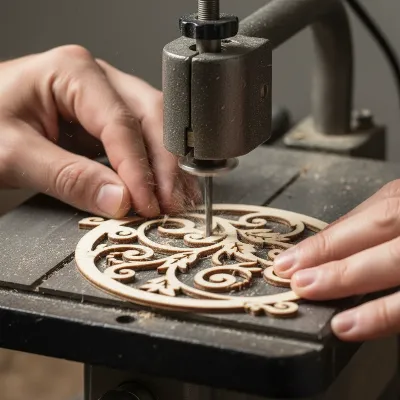 A scroll saw in action, cutting an intricate design into a wooden workpiece
Comparing Popular Scroll Saw Brands
When investing in a scroll saw, brand reputation often correlates with reliability, features, and ease of use. While personal preference plays a role, several manufacturers consistently deliver quality tools. Here’s a comparison of some popular scroll saw brands, considering factors relevant to both general use and blade changing:
| Feature | DeWalt DW788 (Professional) | Wen 3921 (Budget-Friendly) | Ryobi SC165VS (Entry-Level) | Bosch (Limited Models, High Quality) |
|---|---|---|---|---|
| Throat Depth | 20 inches | 16 inches | 16 inches | Varies, typically 16-20 inches |
| Blade Change | Tool-free, quick-release | Tool-free wing nuts | Tool-free, often requires access | Generally tool-free, robust clamps |
| Blade Type | Unpinned | Pinned & Unpinned | Pinned & Unpinned | Unpinned |
| Speed Range | 400-1750 SPM | 500-1750 SPM | 500-1700 SPM | 400-1600+ SPM |
| Vibration | Very Low | Moderate | Moderate | Very Low |
| Table Tilt | 0-45° left & right | 0-45° left | 0-45° left | 0-45° left & right |
| Dust Blower | Integrated, adjustable | Integrated | Integrated | Integrated |
| Price Range | High ($500-$700) | Low ($150-$250) | Low ($120-$200) | High (if available) |
| Blade Tension | Easy access, quick adjustment | Knob-based, manual adjustment | Knob-based, manual adjustment | Precise, often lever-assisted |
- DeWalt: Often considered the industry standard for professional scroll saw work. Known for exceptionally low vibration, robust construction, and a user-friendly tool-free blade change system that simplifies intricate internal cuts. The blade tensioning is precise and easily accessible.
- Wen: A popular choice for beginners and hobbyists due to its affordability. While it may have more vibration than premium models, its tool-free blade change with wing nuts is straightforward. It offers good value for its price point.
- Ryobi: Another entry-level option, often found in major hardware stores. Ryobi scroll saws typically feature tool-free blade changes, though some users find accessing the lower blade clamp a bit awkward. They are a good starting point for casual use.
- Bosch: While Bosch may not offer as many dedicated scroll saw models as other brands, their tools are generally known for high-quality engineering and durability. If a Bosch scroll saw is available, expect smooth operation and reliable performance, often with intuitive blade changing mechanisms.
> “Choosing the right scroll saw involves balancing budget with features. For frequent, detailed work, investing in a model with minimal vibration and an easy blade change system like DeWalt can save immense frustration and improve accuracy.” – John H. Miller, Master Woodworker and Scroll Saw Instructor
Your Ultimate Buying Guide for a Scroll Saw
Selecting the perfect scroll saw depends heavily on your skill level, the types of projects you plan to tackle, and your budget. Consider these factors to make an informed decision that will serve your woodworking needs for years to come.
When choosing a scroll saw, prioritize motor power (indicated by amp ratings), as it dictates how easily the saw cuts through different materials. A variable speed control is essential, allowing you to fine-tune the blade’s speed for optimal cutting performance and to prevent burning or tearing. Throat depth is another critical specification, determining the maximum width of material you can cut from the edge, while a tilting table offers versatility for angled cuts and bevels.
Scroll Saw for Beginners
For newcomers, ease of use and safety features are paramount. Look for models with:
- Tool-less Blade Change: This significantly reduces frustration, especially when frequently changing blades for internal cuts.
- Easy Blade Tension Adjustment: A simple lever or clearly marked knob makes it easier to achieve correct tension, preventing blade breakage and improving cut quality.
- Integrated Dust Blower: Helps keep the cutting line visible, which is crucial for following patterns accurately.
- Moderate Throat Depth (16-18 inches): Sufficient for most beginner projects without being overly cumbersome.
- Variable Speed: Allows you to experiment with different speeds for various materials.Consider brands like Wen or Ryobi for good starter models that offer essential features without a hefty price tag.
Scroll Saw for Professional Woodworkers
Experienced users require robustness, precision, and advanced features to handle demanding projects. Professionals should seek:
- Large Throat Depth (20 inches or more): Essential for cutting large workpieces and intricate fretwork.
- Minimal Vibration: High-quality engineering reduces vibration, leading to smoother cuts and less fatigue during long working sessions.
- Precise Blade Tensioning System: Often with a quick-release lever and fine-tune knob, allowing for rapid and accurate tension adjustments.
- Acceptance of Unpinned Blades: Unpinned blades offer greater variety in sizes and tooth configurations, crucial for very fine detail work.
- Durable Construction: A heavy cast-iron base provides stability and longevity.Premium brands like DeWalt are often favored by professionals for their reliability and performance.
Using and Maintaining Your Scroll Saw: The Safe Blade Change
Proper usage and regular maintenance are critical for extending the life of your scroll saw and, most importantly, ensuring your safety. A key part of this is knowing how to change a scroll saw blade safely and efficiently.
Pre-Operation Checklist
Before powering on your scroll saw, always perform a quick safety check:
- Personal Protective Equipment (PPE): Always wear safety glasses or a face shield to protect your eyes from flying debris. Consider a dust mask, especially when cutting materials that produce fine dust.
- Clean Workspace: Ensure your workbench is clear of clutter, tools, and anything that could interfere with your workpiece or movement.
- Machine Inspection: Check that all guards are in place, the table is clean, and the blade is properly installed and tensioned.
- Unplug the Saw: Always make sure the saw is unplugged when making any adjustments or blade changes.
The Art of Scroll Saw Cutting
Mastering the scroll saw involves developing a feel for the material and blade. Here are a few tips:
- Let the Blade Do the Work: Avoid forcing the material into the blade. Gentle, consistent pressure is key. Forcing can lead to blade breakage, burning, and inaccurate cuts.
- Control Your Feed Rate: The speed at which you push the material through the blade should match the blade’s cutting ability and the material’s density. Slower for intricate curves, faster for straight lines.
- Pivot Smoothly: When cutting curves, use the blade as a pivot point, slowly rotating the workpiece to follow the line.
Essential Safety Measures
Safety should always be your top priority:
- Always Unplug: Before any maintenance, adjustment, or blade change, ensure the saw is unplugged from its power source. This prevents accidental starts.
- Keep Hands Clear: Never place your hands directly in the blade’s path while the saw is running or when making adjustments without the saw unplugged.
- Use the Hold-Down Foot: This accessory helps prevent the workpiece from lifting or vibrating, maintaining control and reducing kickback risk.
- Proper Lighting: Good lighting helps you see your cut line clearly, reducing eye strain and increasing accuracy.
How to Safely Change a Scroll Saw Blade at Home (DIY Guide)
Changing your scroll saw blade is a routine task that becomes second nature with practice. Here’s a step-by-step guide to doing it safely and effectively:
- Safety First: Unplug the Saw. This is the absolute most critical step. Disconnect the saw from the power source to prevent accidental startup and potential injury. Always double-check this.
- Release Blade Tension. Locate the blade tension lever or knob, typically on the top arm of your scroll saw. Loosen it completely to remove tension from the old blade. This makes removal much easier and safer.
- Loosen Blade Clamps/Screws. Your scroll saw will have upper and lower blade clamps. Use the appropriate tool (an Allen wrench, screwdriver, or a quick-release lever, depending on your model) to loosen the screws or clamps that secure the blade. You usually don’t need to remove them entirely, just loosen them enough for the blade to slide out.
- Remove the Old Blade. Carefully slide the old blade out from the clamps. Note its orientation—the teeth almost always face downwards, but observing how the old blade was installed can be helpful. Handle dull or broken blades with care, as they can still cut you.
- Choose the Right New Blade. Select a new blade appropriate for your material and project. Consider the TPI (teeth per inch) for material thickness and the blade type (standard, skip-tooth, reverse-tooth, spiral). For most general cutting, teeth should point downwards.
- Insert the New Blade into the Lower Clamp. Carefully thread the new blade through the hole in your saw’s table. Secure the bottom end of the blade into the lower blade clamp, ensuring it’s fully seated and held firmly by tightening the clamp screw or engaging the lever.
- Attach the Top Clamp. Pull the upper arm down to meet the top of the blade. Insert the top end of the blade into the upper blade clamp, again ensuring it’s properly seated. Tighten the clamp screw or engage the lever.
- Re-Tension the Blade. Once both ends are secured, re-apply tension using your scroll saw’s tension lever or knob. The correct tension is crucial. A good rule of thumb is to gently pluck the blade with your finger; it should produce a clear, high-pitched “ping” sound, similar to a guitar string. If it sounds dull or loose, increase tension. If it’s too tight, it will strain the blade and lead to premature breakage.
- Test Run. Plug the saw back in and turn it on briefly. Listen for any unusual noises or excessive vibration. The blade should run smoothly and appear straight. If anything seems off, unplug the saw and recheck the installation and tension. Once satisfied, you’re ready to cut.
 Worker safely changing a scroll saw blade with power off
Scroll Saw Maintenance & Cleaning
Regular cleaning and maintenance go a long way:
- Dust Removal: Use a shop vac or compressed air to clean sawdust from the motor, moving parts, and under the table after each use.
- Blade Storage: Store new and used blades in a safe, organized manner to prevent damage and easy selection.
- Lubrication: Consult your saw’s manual for any recommended lubrication points. Avoid over-lubricating, as it can attract dust.
Troubleshooting Common Scroll Saw Issues
Even with proper usage and maintenance, you might encounter issues. Here are some common problems and their solutions:
- Blade Breakage: This is often due to improper blade tension (either too loose or too tight) or forcing the material through the blade. Using a dull blade or the wrong blade type for the material can also cause breakage. Solution: Adjust tension, let the blade cut at its own pace, and change to a sharp, appropriate blade.
- Inaccurate or Jagged Cuts: A dull blade is a primary culprit here. Incorrect blade tension (too loose) will cause the blade to wander, leading to uneven cuts. Pushing too hard or having the workpiece lift during the cut can also result in inaccuracies. Solution: Change the blade, adjust tension, and ensure the hold-down foot is properly set.
- Excessive Vibration: Can stem from an unbalanced workpiece, the saw not being securely mounted, or worn components internally. Solution: Ensure your saw is on a stable surface, check the mounting, and investigate if any parts are loose.
- Burning Wood: This usually happens when the blade speed is too fast for the material, the blade is dull, or you’re forcing the workpiece. This generates excessive friction. Solution: Reduce blade speed, change to a sharper blade, and adjust your feed rate. Applying masking tape to the workpiece can also act as a lubricant.
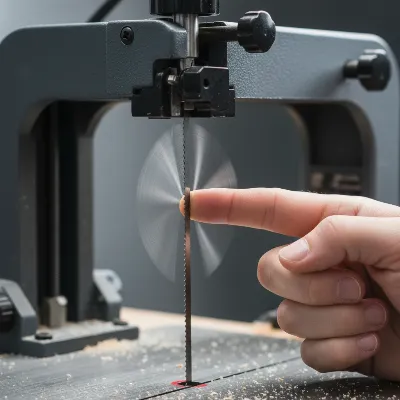 Hand plucking a scroll saw blade to check tension for a "ping" sound
Conclusion
Mastering your scroll saw, particularly the critical task of safely changing its blades, is a skill that enhances both your craftsmanship and your workshop safety. By understanding the different types of saws, their components, and the step-by-step process of blade replacement and tensioning, you empower yourself to tackle any intricate project with confidence. an unplugged saw, the correct blade, and proper tension are the trifecta for successful and safe scrolling. Regular maintenance and attentive troubleshooting will keep your machine running smoothly, allowing you to focus on the joy of creating beautiful, detailed pieces. What new, intricate project will you bring to life with your perfectly maintained scroll saw?
Frequently Asked Questions
How often should I change my scroll saw blade?
The frequency depends on the material you’re cutting, the intricacy of your work, and the blade’s quality. For optimal performance and safety, change your blade as soon as you notice a decline in cutting quality, increased resistance, or visible dullness. Many experienced users change blades at the start of each new project or several times during a complex one.
What is the ‘ping test’ for scroll saw blade tension?
The “ping test” is a common method for checking blade tension. After installing a new blade and applying tension, gently pluck the blade with your fingertip, like a guitar string. A properly tensioned blade will produce a clear, high-pitched “ping” sound. A dull thud indicates insufficient tension, which can lead to wavy cuts and blade breakage.
Can I use any blade with my scroll saw?
No, not all blades are universally compatible. Scroll saw blades come in pinned and unpinned varieties. Most modern scroll saws use unpinned blades for greater versatility, but some older or entry-level models might require pinned blades. Always check your saw’s manual for compatible blade types and sizes.
Why are my scroll saw blades breaking so frequently?
Frequent blade breakage is often a sign of incorrect blade tension (too tight or too loose), forcing the workpiece through the blade, or using a dull blade. Ensure your blade tension is correct, let the blade do the cutting at its own pace, and use sharp blades appropriate for your material.
What tools do I need to change a scroll saw blade?
Most scroll saws feature tool-less blade changes, requiring only your hands. However, some models might need an Allen wrench or a small screwdriver to loosen the blade clamps. Always refer to your specific scroll saw’s user manual to confirm the necessary tools.

Good overview of changing blades. I appreciate the emphasis on safety, which is always important. However, I found the section on understanding scroll saw components a bit basic for someone who’s already looking up how to change a blade. It felt like it could have been more focused on the actual blade swap.
Finally, a guide that makes sense! I was always intimidated by changing the reciprocating blade on my scroll saw, but this made it so easy to understand. My projects are looking much better, and I’m not fighting with loose blades anymore. Definitely bookmarking this for future reference.
I’ve been using a scroll saw for years, but I still picked up some great pointers here. The step-by-step replacement process was really well explained, especially for beginners. My only minor complaint is that I wish there were a few more brand-specific tips, as some saws have slightly different mechanisms.
This guide was a lifesaver! I always struggled with getting the right tension after a blade change, but the tip about the ‘ping’ sound made all the difference. My cuts are so much cleaner now, and I feel a lot more confident tackling those really intricate designs. Thanks for breaking it down so clearly.