Are you captivated by the delicate beauty of finely cut wooden designs, perhaps envisioning elaborate fretwork or personalized puzzles? The scroll saw is an indispensable tool for transforming ordinary wood into extraordinary art, allowing for precision and detail unmatched by many other power tools. While often overlooked by general DIYers, this specialized saw opens up a world of creative possibilities for woodworkers, hobbyists, and artisans alike. This comprehensive guide will navigate you through everything you need to know about scroll saws, from their fundamental mechanics to advanced techniques for cutting the most intricate patterns, ensuring your projects are both successful and inspiring.
What is a Scroll Saw? (Definition and Applications)
A scroll saw is a stationary power tool equipped with a small, reciprocating blade designed to cut intricate curves and delicate patterns in various materials, most commonly wood. Unlike a band saw, which uses a continuous loop blade, a scroll saw’s blade moves rapidly up and down, much like a sewing machine needle. This unique action, combined with extremely fine blades, allows for significantly tighter turns and more detailed cuts than a power jigsaw or even a hand coping saw.
Scroll saws are primarily used for precision-cutting tasks where accuracy and fine detail are paramount. Popular applications include creating decorative fretwork, crafting wooden puzzles, producing intricate intarsia pieces, making delicate joinery like dovetails, and adding elaborate details to furniture and cabinetry. Its ability to create internal cuts by feeding the blade through a pre-drilled hole further expands its versatility for complex designs where an entry slot is not desired. For expert scroll saws reviews on this site.
 A close-up of a scroll saw in action, cutting an intricate pattern into a thin wooden board, with sawdust blowing away, realistic style
Types of Scroll Saws
Scroll saws are primarily categorized by their design and how they hold the blade, impacting their performance and suitability for different tasks. While the majority are benchtop models, some compact, portable options exist.
Benchtop Scroll Saws (Parallel Arm, Parallel Link, C-Arm)
Benchtop scroll saws are the most common type, providing stability and power for detailed work. They are classified by their arm designs, which dictate blade movement and vibration.
- Parallel Arm Scroll Saws: This is the most prevalent design, featuring two arms that move parallel to each other. They offer a good balance of vibration control and precision, making them suitable for a wide range of projects. Many popular models, such as the DeWalt DW788, utilize this design.
- Parallel Link Scroll Saws: Considered high-end, these saws use a more complex pulley system for blade movement. The design significantly reduces vibration, leading to smoother, more accurate cuts, especially beneficial for extremely fine details and commercial use. However, they are typically more expensive.
- C-Arm Scroll Saws: This design features a single, C-shaped arm that pivots. Often found in older or more budget-friendly models, C-arm saws can sometimes exhibit more blade deflection and vibration, potentially affecting accuracy for very intricate work.
Portable Scroll Saws
|
Our Picks for the Best Scroll Saw in 2026
As an Amazon Associate I earn from qualifying purchases.
|
||
| Num | Product | Action |
|---|---|---|
| 1 | Scrolling 101: Everything the Beginner Needs to Know (Fox Chapel Publishing) Scroll Saw Basics, Choosing Blades, Adapting Patterns, Using a Starter Saw, Sanding, and a Skill-Building Exercise Pattern |

|
| 2 | 2025 Scroll saw patterns: Scroll saw patterns: Inspirations for wood lovers: 164 patterns with Trees of Life, Hearts, Sailboats, animal family puzzles, landscapes... |
|
| 3 | Making Wooden People & Pets with Personality: 24 Easy Projects for the Scroll Saw (Fox Chapel Publishing) Full-Size Patterns for Beginners and Intermediate Scrollers to Create Handmade Gifts in Wood |
|
| 4 | Shop Fox W1872 16" VS Scroll Saw with Foot Switch, LED, Miter Gauge, Rotary Shaft |
|
| 5 | FOXBC 5-Inch Scroll Saw Blade Pin End Replacement for Wen 3921 3923, Dremel, Craftsman, Penn State, Delta, Ryobi and All 15in.and 16in.Scroll Saw For Wood, High Carbon Steel - 48 Pack |
|
| 6 | BLACK+DECKER Jig Saw, 4.5 -Amp (BDEJS300C) |
|
| 7 | Big Book of Scroll Saw Woodworking: More Than 60 Projects and Techniques for Fretwork, Intarsia, and Other Scroll Saw Crafts (Fox Chapel Publishing) Patterns for Beginners to Advanced Woodworkers |
|
| 8 | Scroll Saw Workbook, 3rd Edition: Learn to Master Your Scroll Saw in 25 Skill-Building Chapters (Fox Chapel Publishing) Ultimate Beginner's Guide with Projects to Hone Your Scrolling Skills |
|
| 9 | WEN Adjustable Scroll Saw Stand for all WEN and DeWALT® Scroll Saws (MSA1621) |
|
| 10 | 3D Scroll Saw Projects: 35 Fun Compound-Cut Projects, More Than 150 Patterns (Fox Chapel Publishing) Scroll Saw Woodworking & Crafts Magazine Compilation - Ornaments, Home Décor, Chess Set, and More |
|
While less common for heavy-duty or large-scale intricate work, portable scroll saws offer convenience for smaller projects or limited workshop space. Models like the Dremel Moto-Saw are compact and designed for lighter-duty tasks, sometimes allowing blades to be installed in multiple directions for increased versatility. These are excellent for beginners or those with occasional scrolling needs, though they may lack the power and stability of larger benchtop units.
CNC Scroll Saws (Clarification)
While the concept of a “CNC scroll saw” might sound appealing for automated intricate cutting, dedicated machines of this type are exceptionally rare in the market. Most automated intricate cutting tasks in woodworking are typically handled by CNC routers or laser cutters, which use different cutting mechanisms (rotary bits or focused light) to achieve computer-controlled precision. Standard scroll saws remain primarily user-guided tools, offering hands-on control for artisans.
Anatomy and Principles of Operation of a Scroll Saw
Understanding the core components and how they work together is key to maximizing your scroll saw’s potential and maintaining its performance.
Key Components of a Scroll Saw
- Blade: The heart of the scroll saw, these thin, fine-toothed blades reciprocate up and down to cut. They come in various sizes and tooth configurations (e.g., plain, skip tooth, reverse, spiral) for different materials and cut types.
- Blade Clamps (Chucks): These secure the blade at the top and bottom arms. Many modern saws feature tool-free blade clamps for quick and easy blade changes, essential for internal cuts.
- Tension Lever/Knob: Located on the saw, this mechanism adjusts the tension of the blade. Proper tension is critical for straight, clean cuts and preventing blade breakage.
- Motor: Typically a low-horsepower motor (e.g., 1.2-1.6 amps) designed for controlled, variable-speed operation rather than raw power.
- Speed Adjustment Knob: Allows you to vary the strokes per minute (SPM) of the blade. Slower speeds are ideal for intricate work and harder materials, while faster speeds suit general cutting in softer woods.
- Work Table: A flat surface, usually cast iron or aluminum, where the workpiece rests. Many tables can tilt (often up to 45 degrees) to allow for angled or bevel cuts.
- Hold-Down Foot: An adjustable foot that rests on the workpiece, preventing it from lifting with the upward stroke of the blade, which ensures stability and accuracy. It also acts as an additional blade guard.
- Dust Blower/Port: A flexible nozzle that directs air at the cutting area to clear sawdust, maintaining visibility of your cut line. A dust port allows connection to a vacuum for more effective dust collection.
- On/Off Switch: Typically located within easy reach on the front of the saw for quick and safe operation. Some saws also feature a foot pedal for hands-free control.
Basic Principle of Operation
A scroll saw operates by converting the motor’s rotary motion into vertical reciprocating motion for the blade. The blade, held taut by the clamps, moves rapidly up and down through a small opening in the work table. As you guide the material against the blade with your hands, the teeth cut through the wood, following your desired pattern. The ability to quickly release and re-clamp the blade allows for internal cuts: a pilot hole is drilled in the workpiece, the blade is unclipped from the top, threaded through the hole, and then re-clamped and tensioned before cutting begins. This allows for intricate cutouts without needing an external entry point.
Comparing Popular Scroll Saw Brands
When investing in a scroll saw, brand reputation, features, and user experience play a significant role. Here’s a comparison of some well-regarded brands, focusing on aspects crucial for intricate woodworking:
| Feature/Brand | DeWalt (e.g., DW788) | WEN (e.g., 3921, LL2156) | Jet (e.g., JWSS-22B, 18B) | Other Notables (Hegner, Excalibur) |
|---|---|---|---|---|
| Throat Size | 20 inches | 16-21 inches | 18-22 inches | 18+ inches |
| Motor Power | 1.3 Amp | 1.2-1.6 Amp | Typically stronger for heavy-duty | Professional-grade motors |
| Variable Speed | Yes (400-1750 SPM) | Yes (400-1600/1700 SPM) | Yes (400-1550 SPM) | Yes, precise control |
| Vibration | Very Low | Moderate | Low | Extremely Low (renowned) |
| Blade Change | Tool-free, top-feed | Tool-free (some models) | Tool-free, unique upper mechanism | Often tool-free, efficient |
| Blade Compatibility | Pinless only | Pin-end & Pinless | Pinless only | Pinless (high-end blades) |
| Dust Management | Blower, Vacuum Port | Blower, Vacuum Port | Blower, Dust Port | Effective blowers/ports |
| Special Features | Parallel-link arm, comfortable operation, oversized table. | 90-degree blade orientation, budget-friendly. | Integrated blade storage, tilting arm. | Tilting head (Excalibur), exceptional stability (Hegner). |
| Price Range | Mid-High | Budget-Mid | Mid-High | Premium/Pro |
| Ideal User | Serious hobbyists, professionals needing reliable performance. | Beginners, hobbyists, budget-conscious users. | Professionals, advanced hobbyists needing durability. | Elite professionals, those seeking the best performance and vibration control. |
DeWalt DW788: Widely praised as a “workhorse” for its smooth, quiet operation and minimal vibration, making it a favorite among professionals and serious hobbyists. Its parallel-link arm design contributes to excellent cut quality.
WEN: Offers excellent value, particularly for beginners. Many WEN models include variable speed, dust blowers, and can often accept both pin-end and pinless blades, providing flexibility for learning. Some models even allow 90-degree blade rotation for wider workpieces.
Jet: Known for robust construction and features tailored for professional use, such as quick blade changes and tilting arms for bevel cuts. Jet saws are built for durability and precision over long sessions.
Hegner and Excalibur: These brands represent the pinnacle of scroll saw technology, prized for their exceptional vibration control, precision, and longevity. Hegner Multimax series are lauded for their stability, while Excalibur saws often feature unique tilting heads for easier bevel cutting, providing ultimate control for intricate work.
> “The secret to consistent, intricate scroll saw work isn’t just a sharp blade, it’s a saw with minimal vibration. That’s where quality truly shines, allowing your hands to guide the wood with absolute confidence.” – Johan Petrov, Master Scroll Saw Technician
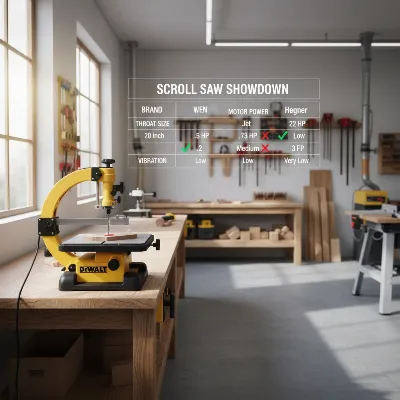 A comparative table showcasing key features of different scroll saw brands, with examples of specific models, realistic workshop background
How to Choose the Right Scroll Saw (Buying Guide)
Selecting the ideal scroll saw depends on your specific needs, skill level, and budget. Consider these factors to make an informed decision:
- Throat Size: This is the distance from the blade to the back of the saw frame. A larger throat (18-22 inches or more) allows you to cut larger workpieces. For most intricate patterns, a 16-inch throat is often sufficient, but a 20-inch model offers more versatility.
- Variable Speed Control: Absolutely essential for intricate work. Different materials and cutting complexities require varying speeds. Slower speeds prevent burning on delicate wood or plastic and offer more control for tight curves. Look for a wide SPM range (e.g., 400-1750 SPM).
- Motor Power: While scroll saws aren’t about raw power, a motor of at least 1.2 amps is recommended for consistent performance, especially when cutting thicker hardwoods or stacking multiple pieces (pad sawing).
- Vibration: Less vibration translates to greater accuracy and less fatigue. High-quality saws, especially those with parallel-link arm designs, are engineered to minimize vibration, offering a smoother cutting experience.
- Blade Compatibility: Saws that accept both pin-end and pinless (plain-end) blades offer more flexibility. Pinless blades are crucial for the finest detail work as they require smaller pilot holes for internal cuts and come in a wider variety of fine tooth configurations.
- Ease of Blade Changes: For intricate patterns involving many internal cuts, quick, tool-free blade changes are invaluable. Look for easily accessible clamps and a blade tension release system.
- Table Size and Tilt: A larger, sturdy table provides better support for your workpiece. The ability to tilt the table (or the arm in some designs) is necessary for making bevel cuts. Ensure the tilt mechanism is easy to adjust and lock securely.
- Dust Management: A good dust blower keeps your cut line visible. A dust port for connecting a shop vacuum is highly recommended for a cleaner workspace and better air quality.
- Safety Features: A workpiece hold-down foot prevents lifting, and an easily accessible on/off switch is vital. Some saws offer a foot pedal, freeing both hands for guiding the workpiece.
- Budget: Scroll saws range from under $100 to over $1500. Invest in the best saw you can comfortably afford, as quality often correlates with reduced vibration, greater precision, and longer tool life.
Scroll Saw for Beginners
For newcomers, ease of use and forgiveness are key. A scroll saw with:
- Tool-free blade changes and compatibility with both pin-end and pinless blades
- Variable speed control for learning different techniques
- A moderate throat size (16-inch is a good starting point)
- An LED work light and a dust blower for clear visibility
- A stable cast-iron base to minimize vibration.
Brands like WEN, Skil, or some Ryobi models often offer excellent value for beginners, providing sufficient features without a prohibitive price tag. The DeWalt DW788, while a higher investment, is also frequently recommended for beginners dueishing to its exceptionally smooth operation and low learning curve.
Scroll Saw for Professional Woodworkers
Professionals and advanced hobbyists demand precision, durability, and features that enhance productivity and fine detail. Look for:
- Large throat depth (20 inches or more) for diverse projects.
- Powerful, low-vibration motors.
- Parallel-link arm designs for superior accuracy and reduced fatigue during long sessions.
- Exclusive use of pinless blades for the finest fretwork.
- Advanced features like tilting arms (rather than just tables) and robust dust collection.
- Brands like Hegner, Excalibur, and the DeWalt DW788 are often the top choices for professional-grade performance.
How to Use and Maintain Your Scroll Saw
Proper usage and regular maintenance are crucial for safety, extending the life of your scroll saw, and consistently achieving high-quality cuts, especially when tackling intricate designs.
Preparing for Scroll Saw Operation
Before you even plug in your saw, preparation is paramount:
- Work Area: Ensure your workspace is clean, well-lit, and free of clutter. Adequate ventilation is also important for dust.
- Safety Gear: Always wear safety glasses to protect your eyes from sawdust and potential blade breakage. A dust mask is advisable to avoid inhaling fine wood particles. Tie back long hair and avoid loose clothing or jewelry that could get caught in moving parts.
- Blade Selection: Choose the correct blade for your material and desired cut. Finer blades (#2/0, #1, higher TPI) are best for intricate patterns and thin stock, while coarser blades are for thicker wood or faster cuts. Spiral blades allow cutting in any direction without rotating the workpiece.
- Blade Installation and Tension: Insert the blade with the teeth pointing downwards and forwards towards the table. Securely clamp both ends. Adjust the blade tension: it should be tight enough to produce a high-pitched “ping” when plucked like a guitar string, but not so tight that it feels brittle. Too little tension causes blade deflection; too much can lead to breakage.
- Workpiece Preparation: Attach your pattern securely to the workpiece using spray adhesive or clear packing tape. For internal cuts, drill small pilot holes (just large enough for your blade) at the starting point of each interior section. Sand the underside of the workpiece if it’s uneven to prevent bouncing.
- Adjust Settings: Set the hold-down foot to lightly press against your workpiece. Adjust the speed setting; start slow for intricate cuts, hard materials, or as a beginner, and increase as needed for straight lines or softer woods. Turn on the dust blower.
Essential Cutting Techniques for Intricate Patterns
Mastering the scroll saw for intricate patterns requires patience and a gentle touch:
- Guidance is Key: Use both hands to gently guide the workpiece into the blade, following your pattern lines. Avoid forcing the wood; let the blade do the cutting at its own pace. Excessive pressure can cause blade deflection, breakage, or burning.
- Steady Feed Rate: Maintain a consistent, slow feed rate for intricate curves and tight turns. For longer, straighter lines, you can slightly increase the feed rate, but never push aggressively.
- Turning: For curves, slowly rotate the workpiece as you feed it forward. For very tight turns or sharp corners, you might need to stop feeding forward, pivot the workpiece slightly with the blade still running in place (allowing the blade to “nibble” away material), and then resume feeding.
- Interior Cuts: After drilling pilot holes, unclamp the top of the blade, thread it through a pilot hole, re-clamp, and re-tension. Complete the interior cut, then reverse the process to free the workpiece.
- Relief Cuts: For complex designs with many tight turns or long, winding cuts, make “relief cuts” into the waste material. These are short, straight cuts that remove excess material, reducing strain on the blade and making it easier to maneuver the workpiece through intricate sections.
- Practice, Practice, Practice: Start with simpler patterns and scrap wood. Your control and confidence will rapidly improve with practice.
Scroll Saw Safety Measures
While generally considered safer than many other power saws, a scroll saw still demands respect:
- Always Wear Eye Protection: This is non-negotiable.
- Keep Hands Clear: Always be aware of the blade’s path. Use the hold-down foot to keep your fingers safely away. Maintain a safe distance (e.g., the 8 cm rule suggested by some professionals) from the blade.
- Unplug for Adjustments: Before changing blades, adjusting tension, or performing any maintenance, always unplug the saw.
- Secure Workpiece: Never attempt to cut freehand in mid-air. Always keep the workpiece flat against the table.
- No Loose Items: Ensure loose clothing, jewelry, or long hair cannot get caught.
- Cut Dry Wood: Wet wood is denser, harder to cut, and can lead to burning, blade wear, and rust.
- Inspect Blades: Before each use, check the blade for sharpness, damage, or bends. Replace dull or damaged blades immediately.
Maintenance and Cleaning for Longevity
Regular care will keep your scroll saw performing optimally for years:
- Clean After Each Use: Vacuum or brush away sawdust from the table, arm, and motor housing. Use compressed air to clear sawdust from the blade clamps and dust blower nozzle.
- Release Blade Tension: When the saw is not in use, release the blade tension. This prevents unnecessary strain on the saw’s components and extends blade life.
- Lubricate the Table: Apply a light coat of high-quality paste wax or silicone spray to the work table. This reduces friction, allowing the workpiece to glide smoothly, and helps prevent rust. Avoid petroleum-based lubricants on rubber parts.
- Check Clamps: Periodically inspect blade clamps for wear. Overtightening can spread the jaws, leading to blades slipping. If a clamp is faulty, replace it.
- Lubricate Bearings (Advanced): For some models, especially after extended use, lubricating internal bearings with synthetic grease can reduce noise and extend motor life. Refer to your saw’s manual for specific instructions.
- Store Blades Properly: Keep spare blades organized and protected from rust in a dry environment.
- Inspect Power Cord: Routinely check the power cord for any damage or fraying.
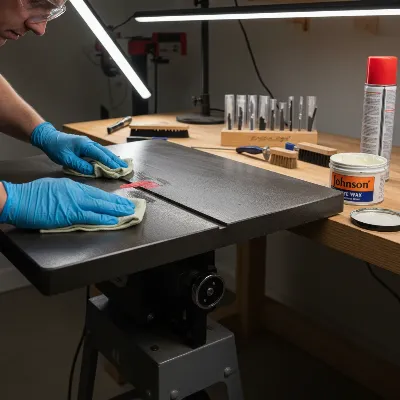 A person cleaning and lubricating a scroll saw table with a cloth and paste wax, tools and sawdust visible, clean workshop setting, realistic style
Common Issues and How to Fix Them When Using a Scroll Saw
Even with careful use, you might encounter some common scroll saw problems. Knowing how to troubleshoot them can save you time and frustration.
Blade Breaks Frequently
This is one of the most common and frustrating issues.
- Possible Causes:
- Improper Tension: Both too much and too little tension can cause blades to snap.
- Excessive Pressure: Forcing the workpiece through the blade instead of letting the blade cut at its own pace.
- Dull Blade: A dull blade requires more force and generates more heat, leading to breakage.
- Overheating: Cutting thick or dense materials continuously without pauses can weaken the blade.
- Misalignment: If the blade isn’t perfectly straight or clamps are overtightened, uneven stress can cause snapping.
- Solutions:
- Adjust blade tension to a firm, resonant “ping” sound.
- Use a light, steady hand; let the saw do the work.
- Replace dull blades immediately.
- Apply painter’s tape or clear packing tape to the workpiece as a lubricant to reduce friction and burning.
- Ensure the blade is seated perfectly straight in the clamps and tightened snugly, not excessively.
Cuts Are Not Perpendicular or Blade Drifts
If your cuts aren’t straight or veer off course, check these factors.
- Possible Causes:
- Under-tensioned Blade: A loose blade will deflect easily.
- Blade Not Square to Table: The blade might not be at a perfect 90-degree angle to the table.
- Forcing the Blade Sideways: Pushing the workpiece unevenly can cause the blade to wander.
- Blade Drift: Some blades, particularly stamped ones, can naturally drift due to manufacturing burrs.
- Solutions:
- Increase blade tension until it’s firm.
- Check the blade-to-table squareness with a small square and adjust the table if necessary.
- Guide the workpiece with even pressure, allowing the blade to cut without forcing it laterally.
- Experiment with precision-ground blades (like Pegas MGT) which are known for less drift.
Excessive Burning on Wood
Burning indicates excessive friction or heat build-up.
- Possible Causes:
- Wrong Blade Type/Size: A blade too fine for the material or too small for the thickness.
- Too Fast a Speed: High speeds on dense wood can quickly generate heat.
- Dull Blade: Increases friction as it struggles to cut.
- Solutions:
- Use a blade with a coarser tooth count or one specifically designed for thicker/harder woods.
- Reduce the cutting speed.
- Replace dull blades.
- Apply masking or clear packing tape to the workpiece; it acts as a lubricant.
Workpiece Bounces or Lifts Excessively
This can lead to inaccurate cuts and potential safety hazards.
- Possible Causes:
- Uneven Underside: The workpiece isn’t sitting flat on the table.
- Hold-Down Foot Not Adjusted: Not properly set to press lightly on the material.
- Blade Inserted Upside Down: Though less common with modern blades, incorrect orientation means teeth aren’t cutting effectively.
- Solutions:
- Sand the underside of your workpiece flat before cutting.
- Adjust the hold-down foot so it rests gently on the workpiece, preventing it from lifting with the blade’s upward stroke.
- Ensure the blade teeth are pointing downwards and forwards.
Saw Runs Rough or Vibrates Excessively
Increased vibration affects precision and user comfort.
- Possible Causes:
- Loose Mounting: The saw isn’t securely fastened to its bench or stand.
- Worn Arm Pivots/Bearings: Internal mechanical wear can cause wobbling.
- Incorrect Blade Tension: Can contribute to erratic movement.
- Solutions:
- Ensure your scroll saw is firmly screwed down to a sturdy workbench or a heavy, stable stand.
- If vibration persists, check your saw’s manual for guidance on adjusting arm pivots or lubricating/replacing bearings. For significant internal wear, professional servicing might be required.
- Verify correct blade tension.
When to Seek Professional Help
While many issues can be self-corrected, always consider professional servicing if:
- The motor experiences significant strain or makes unusual noises.
- You consistently encounter problems that cannot be resolved with basic troubleshooting.
- There’s structural damage to the saw’s arms or frame.
- Electrical issues like blown fuses persist after checking outlets.
Conclusion
The scroll saw is a remarkable tool for anyone passionate about crafting intricate wood patterns. From delicate fretwork to personalized wooden puzzles, its precision and versatility open endless creative avenues. By understanding its components, selecting the right model for your needs, and diligently applying proper usage and maintenance techniques, you can master this specialty saw. patience, practice, and adherence to safety guidelines are your most valuable assets. So, what intricate design will you bring to life first with your scroll saw?
Frequently Asked Questions
What kind of wood is best for intricate scroll saw patterns?
Softer woods like poplar, basswood, and pine are often ideal for beginners due to their ease of cutting. For more detailed and durable projects, hardwoods like maple, cherry, or walnut can be used, but they require finer blades, slower speeds, and more patience to prevent burning and blade breakage.
How do I prevent blade breakage when cutting tight curves?
To prevent blade breakage, ensure your blade tension is correct – not too tight, not too loose. Reduce your cutting speed, particularly in tight turns, and avoid forcing the workpiece. Making small “relief cuts” into waste areas can also significantly reduce stress on the blade during intricate maneuvers.
Can I cut materials other than wood with a scroll saw?
Yes, scroll saws can cut a variety of materials including plastics (like acrylic), thin metals (like brass or aluminum), and even softer materials like leather or composite boards. Always use the appropriate blade type and speed for the material to ensure a clean cut and prevent damaging the blade or workpiece.
What’s the difference between pin-end and pinless scroll saw blades?
Pin-end blades have small pins at each end for easy installation, making them popular with beginners, but they require larger pilot holes and offer less variety for fine detail. Pinless (or plain-end) blades are secured by clamps and come in a wider range of sizes and tooth patterns, allowing for superior
