Optimizing scroll saw performance involves regular maintenance, and a key aspect is lubricating the bearings. Many scroll saws leave the factory with insufficient lubrication, leading to premature wear and a shorter lifespan. This guide, crafted by an experienced scroll saw technician, details how to quickly and effectively lubricate your scroll saw bearings at home, ensuring your machine runs quieter, smoother, and lasts for years.
Understanding Scroll Saw Bearings and Why They Need Lubrication
Scroll saw bearings are critical components that facilitate the smooth, low-friction movement of various oscillating and rotating parts within your machine. They are typically found in the upper and lower rocker assemblies, which control the blade’s vertical motion, as well as the motor shaft and other pivot points that manage tension and blade movement. These bearings reduce metal-on-metal contact, allowing parts to glide effortlessly and precisely.
Proper lubrication of these bearings is paramount for several reasons. Primarily, it minimizes friction and heat generation, which are the main causes of wear and tear. Adequate lubrication ensures that your scroll saw operates quietly, without the distracting and damaging noises of unlubricated metal surfaces. It also helps prevent premature component failure, extends the overall lifespan of your tool, and maintains the precision required for intricate woodworking projects.
Signs that your scroll saw bearings might need attention include an increase in operational noise, such as grinding, squealing, humming, or rattling sounds. You might also notice excessive vibration during use, or the saw’s arms may feel stiff and resistant when moving. Overheating around the pivot points is another tell-tale sign of lubrication issues, as is any visible surface damage like flaking or pitting on exposed bearing surfaces, or even leaking lubricant from sealed units. Addressing these symptoms promptly can prevent more extensive and costly repairs.
Choosing the Right Lubricant for Your Scroll Saw Bearings
Selecting the appropriate lubricant is crucial for effective scroll saw bearing maintenance, as using the wrong product can do more harm than good. The primary goal is to provide a lasting protective barrier that reduces friction and withstands the operational stresses of your machine.
Types of Lubricants
For scroll saw bearings, synthetic grease is widely considered the superior choice by many experts and experienced users. This type of lubricant adheres well to metal surfaces, provides excellent protection against wear, and maintains its consistency over time and varying temperatures. Specifically, a high-quality synthetic grease formulated for bearings, such as Valvoline Synthetic Grease or similar automotive wheel bearing grease (NLGI #2 grade lithium complex EP grease), is often recommended. This kind of grease ensures long-term lubrication and helps prevent the notorious bearing issues common in scroll saws.
What to Avoid
|
Our Picks for the Best Scroll Saw in 2026
As an Amazon Associate I earn from qualifying purchases.
|
||
| Num | Product | Action |
|---|---|---|
| 1 | Shop Fox W1872 16" VS Scroll Saw with Foot Switch, LED, Miter Gauge, Rotary Shaft |

|
| 2 | BLACK+DECKER Jig Saw, 4.5 -Amp (BDEJS300C) |
|
| 3 | FOXBC 5-Inch Scroll Saw Blade Pin End Replacement for Wen 3921 3923, Dremel, Craftsman, Penn State, Delta, Ryobi and All 15in.and 16in.Scroll Saw For Wood, High Carbon Steel - 48 Pack |
|
| 4 | Scrolling 101: Everything the Beginner Needs to Know (Fox Chapel Publishing) Scroll Saw Basics, Choosing Blades, Adapting Patterns, Using a Starter Saw, Sanding, and a Skill-Building Exercise Pattern |
|
| 5 | WEN Adjustable Scroll Saw Stand for all WEN and DeWALT® Scroll Saws (MSA1621) |
|
| 6 | 2025 Scroll saw patterns: Scroll saw patterns: Inspirations for wood lovers: 164 patterns with Trees of Life, Hearts, Sailboats, animal family puzzles, landscapes... |
|
| 7 | Making Wooden People & Pets with Personality: 24 Easy Projects for the Scroll Saw (Fox Chapel Publishing) Full-Size Patterns for Beginners and Intermediate Scrollers to Create Handmade Gifts in Wood |
|
| 8 | Scroll Saw Workbook, 3rd Edition: Learn to Master Your Scroll Saw in 25 Skill-Building Chapters (Fox Chapel Publishing) Ultimate Beginner's Guide with Projects to Hone Your Scrolling Skills |
|
| 9 | Big Book of Scroll Saw Woodworking: More Than 60 Projects and Techniques for Fretwork, Intarsia, and Other Scroll Saw Crafts (Fox Chapel Publishing) Patterns for Beginners to Advanced Woodworkers |
|
| 10 | 3D Scroll Saw Projects: 35 Fun Compound-Cut Projects, More Than 150 Patterns (Fox Chapel Publishing) Scroll Saw Woodworking & Crafts Magazine Compilation - Ornaments, Home Décor, Chess Set, and More |
|
It is absolutely critical to avoid certain products when lubricating your scroll saw bearings. WD-40, for instance, should never be used as a primary lubricant for bearings. While it can act as a penetrating oil to free seized parts or remove rust, it is primarily a degreaser and will strip away any existing beneficial lubrication, leaving the bearings more vulnerable to wear. Similarly, light oils like 3-in-1 oil are generally not recommended for main bearings. These oils tend to thin out, spin off moving parts quickly, and can attract sawdust and debris, creating a gummy, abrasive paste that accelerates wear rather than preventing it. While some older manuals might suggest SAE 30 oil, modern synthetic greases offer superior performance and longevity for the demanding environment of a scroll saw.
> “Using the correct synthetic grease is the secret to extending the life of your scroll saw bearings. Avoid light oils and especially degreasers like WD-40, as they will do more damage than good over time.” — Admin, ReviewByJoh.com, Scroll Saw Expert
Essential Tools and Safety Precautions Before You Start
Before you begin the lubrication process, gather all necessary tools and prioritize safety to ensure a smooth and accident-free maintenance session. Preparing your workspace and yourself is as important as the lubrication itself.
Tools You’ll Need
Having the right tools at hand will make the job much easier and more efficient. You will likely need a set of screwdrivers (both Phillips and flathead), various wrenches (including small open-ended wrenches and possibly a ratchet set), and Torx bits or Allen keys, depending on your scroll saw model’s fasteners. A flashlight can be incredibly helpful for illuminating hidden bearing locations. For cleaning, stock up on clean rags, pipe cleaners, and Q-tips to remove old grease and debris from tight spots. And, of course, have your chosen synthetic grease ready, along with a small brush for application if it’s not in a dispenser.
Safety First
Your safety is paramount. Always begin by unplugging your scroll saw from the power outlet to prevent accidental startup and potential injury. Wear safety glasses to protect your eyes from dust, debris, or lubricant splashes, especially during cleaning or disassembly. Work in a well-lit, clear workspace where you have ample room to maneuver and place disassembled parts. Keeping your workspace organized will also prevent small components from getting lost. If you’re working with any solvents for cleaning, ensure good ventilation to avoid inhaling fumes.
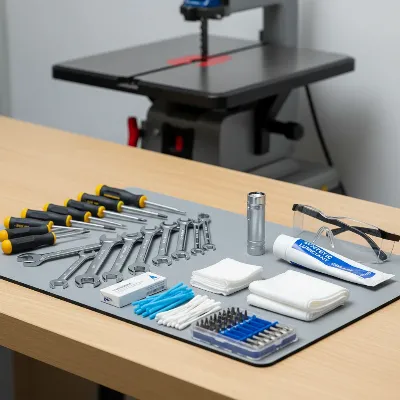 Scroll saw maintenance tools and safety glasses on a workbench with a scroll saw
Step-by-Step Guide: Lubricating Your Scroll Saw Bearings
Lubricating your scroll saw bearings effectively requires careful disassembly, thorough cleaning, and precise application of the new lubricant. Follow these steps to ensure a comprehensive and beneficial maintenance procedure.
Locating the Bearings
Scroll saws typically have several key lubrication points, primarily involving the moving arms and motor assembly. The most critical bearings are often found in the upper and lower rocker assemblies, which are the pivot points where the arms attach to the main body and facilitate the blade’s up-and-down motion. On many models, these might be hidden under plastic caps or integrated within the arm structures. Another crucial area is the motor shaft bearing(s), which supports the rotation of the motor that drives the blade mechanism. Some saws also have bushings or bearings in the blade tension mechanism or other linkages that connect the motor to the lower arm. Consulting your saw’s manual or online repair guides specific to your model (like the popular DeWalt 788 maintenance guides) can provide exact locations and disassembly instructions.
Cleaning the Bearings
Before applying new lubricant, it is essential to clean away any old, dried-out grease, sawdust, and grime that may have accumulated. This prevents abrasive particles from damaging the fresh lubricant and the bearing surfaces.
- Disassemble for Access: Carefully remove any covers, plates, or components that obstruct access to the bearings. Take photos as you go to aid in reassembly.
- Remove Old Lubricant: Use clean rags, Q-tips, and pipe cleaners to meticulously wipe away old grease and any visible debris. For stubborn, hardened grease or significant grime, a mild degreaser (non-petroleum-based, if possible, and applied sparingly) can be used, followed by a thorough wipe-down to ensure no residue remains. The goal is to get the bearing surfaces as clean as possible.
- Inspect Bearings: While cleaning, inspect the bearing surfaces and associated metal sleeves. They should be smooth and free of any vertical dents, pitting, or discoloration. If you notice significant damage, the bearing may be beyond lubrication and require replacement.
Applying the Lubricant
Once the bearings are clean and inspected, you can apply the new synthetic grease.
- Apply Liberally but Thoughtfully: Using a small brush or the nozzle of your grease tube, apply a generous amount of synthetic grease directly onto the exposed bearing surfaces and pivot points. Work the grease into the bearing, ensuring it penetrates any accessible gaps. Don’t be shy, but also avoid over-packing, which can create a mess and potentially attract more dust over time. The idea is to create a robust, even coating that will provide a long-lasting protective layer.
- Lubricate Related Components: any associated metal sleeves, washers (especially “wavy washers” which help reduce stress and noise), and other metal-on-metal contact points in the rocker assemblies. A small dab of grease on the blade tension wedge, for example, can also contribute to smoother operation.
- Repeat as Needed: For deeply set bushings or less accessible areas, you might apply a quick squirt, allow capillary action to draw it in, wait a few minutes, and then repeat once if the surface appears dry, ensuring the lubricant has a chance to penetrate.
Reassembly and Testing
After lubricating all identified points, carefully reassemble your scroll saw.
- Reverse Disassembly Steps: Follow your photos or mental notes to put all components back together correctly. Ensure all fasteners are tightened securely, but avoid over-tightening, which can strip threads or restrict movement.
- Initial Movement Check: Before plugging in the saw, manually move the upper and lower arms to feel for any binding or resistance. They should move smoothly and freely.
- Power Test: Plug in the saw and turn it on at a low speed. Listen for any unusual noises and observe the movement of the arms. The saw should run quieter and with less vibration than before. If new noises or vibrations appear, immediately unplug the saw and re-inspect the areas you worked on for any misplaced parts or improper assembly.
Common Issues and Troubleshooting Bearing Lubrication
Even with careful maintenance, issues can arise. Knowing how to identify and address common problems related to scroll saw bearing lubrication can save you time and prevent further damage.
One common issue is over-lubrication. While it might seem counterintuitive, applying too much grease can be problematic. Excess lubricant, especially in open areas, can attract sawdust, chips, and other airborne debris, turning the smooth grease into an abrasive paste that actually increases wear. If you notice grease oozing from a bearing or a greasy mess forming, wipe away the excess with a clean rag. For sealed bearings, excess grease on the outside usually indicates a damaged seal, which means the internal lubricant is likely compromised or escaping.
Conversely, under-lubrication is a primary cause of bearing failure. If, after following the lubrication steps, your scroll saw still exhibits persistent noise, excessive vibration, or feels stiff, it’s possible that not enough lubricant reached the critical surfaces, or the lubricant used was unsuitable. In this case, a thorough re-cleaning and re-application of a high-quality synthetic grease may be necessary. Ensure you are targeting all the critical pivot points and working the grease into the bearings.
Sometimes, lubrication alone isn’t enough because the bearings are already damaged. If, upon inspection, you find visible signs of wear such as pitting, flaking, discoloration, or vertical dents on the metal sleeves associated with the bearings, then the bearing itself is likely compromised. Noise (like a consistent grinding or squealing) and extreme heat that persists despite proper lubrication are strong indicators of internal damage. In these scenarios, the bearing or the entire assembly containing it will need to be replaced. Continuing to operate the saw with damaged bearings will only lead to further mechanical stress, reduced precision, and potentially catastrophic failure of other components.
Conclusion
Regular and proper lubrication of your scroll saw’s bearings is an often-overlooked yet critical aspect of machine maintenance that significantly impacts its performance and longevity. By understanding where these vital components are located, choosing the right synthetic grease, and following a methodical cleaning and application process, you can prevent premature wear, reduce irritating noise and vibration, and ensure your scroll saw operates with the precision and smoothness it was designed for. your scroll saw is an investment, and a little proactive care goes a long way in protecting it. How often do you check your scroll saw’s bearings, and what benefits have you noticed from consistent lubrication?
Frequently Asked Questions
How often should I lubricate my scroll saw bearings?
While specific intervals vary by manufacturer and usage, a general rule is to inspect and lubricate your scroll saw bearings annually, or every 100-200 hours of heavy use, especially if you notice increased noise or vibration.
Can I use household oil for scroll saw bearings?
No, it’s generally not recommended to use light household oils like 3-in-1 oil for scroll saw bearings. These oils can break down quickly, attract dust, and are less effective at protecting against the wear sustained by the high-speed motion of scroll saw components.
What are the signs of bad scroll saw bearings?
Common signs include unusual noises (grinding, squealing, humming, rattling), excessive vibration, increased heat around the bearing areas, and noticeable stiffness or resistance in the saw’s moving arms.
Is WD-40 good for lubricating scroll saw bearings?
Absolutely not. WD-40 is primarily a penetrating oil and degreaser. Using it on bearings will strip away any existing lubrication, leaving them unprotected and accelerating wear rather than preventing it.
Do all scroll saws have accessible bearings for lubrication?
Many scroll saws, particularly older or higher-end models, have bearings that can be accessed and lubricated. However, some newer or more budget-friendly saws may have “sealed for life” bearings that are not designed for user maintenance and would require replacement if they fail.
What kind of grease should I use for scroll saw bearings?
High-quality synthetic grease, such as a lithium-complex EP grease (NLGI #2 grade) or a specific synthetic wheel bearing grease, is ideal. These greases offer excellent adhesion, heat resistance, and long-lasting lubrication for scroll saw components.
Lubricating Your Scroll Saw Bearings at Home
This guide provides step-by-step instructions for effectively lubricating your scroll saw bearings, ensuring smooth operation and extending the tool's lifespan.
Identify key lubrication points, primarily in the upper and lower rocker assemblies and the motor shaft. Consult your scroll saw's manual for exact locations and carefully disassemble any covers or components obstructing access. Take photos during disassembly to aid in reassembly.
Before applying new lubricant, meticulously wipe away old grease, sawdust, and grime using clean rags, Q-tips, and pipe cleaners. For stubborn grime, a mild, non-petroleum-based degreaser can be used sparingly, followed by a thorough wipe-down to ensure no residue remains. Inspect bearing surfaces for damage like pitting or discoloration.
Once bearings are clean, apply a generous amount of high-quality synthetic grease directly onto exposed bearing surfaces and pivot points using a small brush or grease tube nozzle. Ensure the grease penetrates accessible gaps, creating a robust, even coating. Also, lubricate associated metal sleeves and washers.
Carefully reassemble your scroll saw, following your disassembly photos. Ensure all fasteners are securely tightened without over-tightening. Manually move the arms to check for smooth, free movement before plugging in the saw. Finally, power on the saw at a low speed, listening for unusual noises and observing arm movement to confirm quieter, smoother operation.

The advice on preventing premature wear is solid, and I appreciate the detailed instructions. However, I found it a bit tricky to access some of the pivot points on my specific scroll saw model. It would have been helpful to have some general tips for reaching those harder-to-get-to spots, or maybe a note about tools that could help.
Great tips here! I’ve been using my scroll saw for years and never really thought about the motor shaft bearings. Following the steps for lubrication made a noticeable difference in how smoothly the motor runs. I wish I’d known about this sooner, but better late than never to extend the life of my machine.
I always wondered why my scroll saw sounded like a dying cat after a few months, even with regular cleaning. This guide on lubricating the upper and lower rocker assemblies was a game-changer! My machine is so much quieter now, and the blade movement feels incredibly smooth. Definitely worth the small effort for such a big improvement in performance.
This guide is fantastic! I always assumed my scroll saw was just getting old and noisy, but it turns out it just needed some proper bearing lubrication. The explanation of how bearings reduce metal-on-metal contact really helped me understand why this maintenance is so important. My projects are coming out much cleaner now that my saw isn’t vibrating as much.