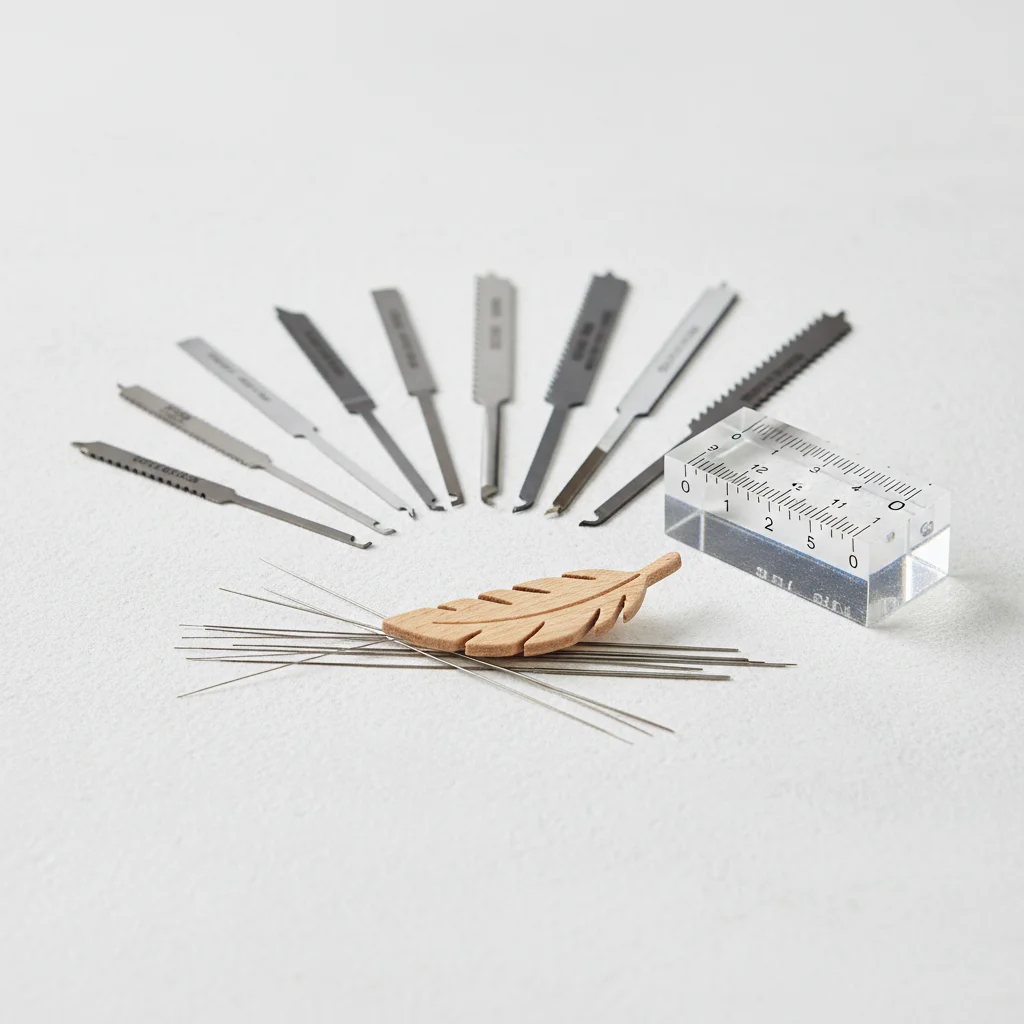
Choosing the correct scroll saw blade thickness is crucial for achieving delicate and intricate cuts in your woodworking projects. For the most delicate work, blades with a thickness ranging from 0.010 to 0.018 inches are generally considered ideal. These thinner blades allow for tighter turns and minimize material removal, resulting in cleaner, more precise details.
Understanding Blade Thickness and Its Impact
Scroll saw blade thickness directly affects the kerf, which is the width of the cut made by the blade. Thinner blades create a narrower kerf, which is essential when working on small, delicate pieces or when intricate details are required. A narrower kerf also means less material is removed, reducing the risk of splintering or damaging the workpiece, especially with softer woods or veneers. Conversely, thicker blades are more robust and suitable for straight cuts or larger, less detailed projects where durability is prioritized over extreme precision.
The material you are cutting also plays a role in determining the optimal blade thickness. For very soft woods or thin plywood, a thinner blade will glide through with minimal resistance. When working with slightly harder materials, a blade on the thicker end of the delicate range (around 0.018 inches) might offer a better balance of flexibility and strength, preventing premature blade breakage while still allowing for fine detail.
Matching Blade Thickness to Project Intricacy
For projects demanding extreme detail, such as creating miniature dollhouse furniture, intricate fretwork, or detailed marquetry, a blade with a thickness of 0.010 to 0.014 inches is often preferred. These blades are incredibly fine and allow for turns with a very small radius, enabling the creation of complex patterns and tight curves. However, these blades are also more prone to breaking if not handled with care, requiring a steady hand and a gentle feed rate.
When your project involves delicate but slightly larger elements, or if you are still developing your scroll saw skills, a blade thickness of 0.015 to 0.018 inches can be a good compromise. These blades offer a bit more stability than their ultra-thin counterparts while still providing excellent control for detailed work. They are less likely to deflect and can handle a slightly faster feed rate without compromising the quality of the cut.
Tips for Working with Thin Scroll Saw Blades
|
Our Picks for the Best Scroll Saw in 2026
As an Amazon Associate I earn from qualifying purchases.
|
||
| Num | Product | Action |
|---|---|---|
| 1 | 3D Scroll Saw Projects: 35 Fun Compound-Cut Projects, More Than 150 Patterns (Fox Chapel Publishing) Scroll Saw Woodworking & Crafts Magazine Compilation - Ornaments, Home Décor, Chess Set, and More |

|
| 2 | Making Wooden People & Pets with Personality: 24 Easy Projects for the Scroll Saw (Fox Chapel Publishing) Full-Size Patterns for Beginners and Intermediate Scrollers to Create Handmade Gifts in Wood |
|
| 3 | Big Book of Scroll Saw Woodworking: More Than 60 Projects and Techniques for Fretwork, Intarsia, and Other Scroll Saw Crafts (Fox Chapel Publishing) Patterns for Beginners to Advanced Woodworkers |
|
| 4 | Scrolling 101: Everything the Beginner Needs to Know (Fox Chapel Publishing) Scroll Saw Basics, Choosing Blades, Adapting Patterns, Using a Starter Saw, Sanding, and a Skill-Building Exercise Pattern |
|
| 5 | Shop Fox W1872 16" VS Scroll Saw with Foot Switch, LED, Miter Gauge, Rotary Shaft |
|
| 6 | Scroll Saw Workbook, 3rd Edition: Learn to Master Your Scroll Saw in 25 Skill-Building Chapters (Fox Chapel Publishing) Ultimate Beginner's Guide with Projects to Hone Your Scrolling Skills |
|
| 7 | BLACK+DECKER Jig Saw, 4.5 -Amp (BDEJS300C) |
|
| 8 | 2025 Scroll saw patterns: Scroll saw patterns: Inspirations for wood lovers: 164 patterns with Trees of Life, Hearts, Sailboats, animal family puzzles, landscapes... |
|
| 9 | WEN Adjustable Scroll Saw Stand for all WEN and DeWALT® Scroll Saws (MSA1621) |
|
| 10 | FOXBC 5-Inch Scroll Saw Blade Pin End Replacement for Wen 3921 3923, Dremel, Craftsman, Penn State, Delta, Ryobi and All 15in.and 16in.Scroll Saw For Wood, High Carbon Steel - 48 Pack |
|
- Always use a slow and consistent feed rate to prevent blade breakage.
- Ensure your workpiece is securely held to minimize vibration.
- Practice on scrap material to get a feel for the blade’s capabilities.
- Keep a supply of extra blades on hand, as thin blades can break easily.
- Consider using a zero-clearance insert to reduce tear-out on delicate pieces.
Proper tensioning is also critical when using thin blades. Too little tension can cause the blade to wander or break, while too much tension can also lead to breakage. Refer to your scroll saw’s manual for recommended tension settings, and always perform a quick ‘pluck’ test – a properly tensioned blade will produce a clear, high-pitched tone when plucked.
Recommended Blades for Delicate Work
Several manufacturers offer high-quality scroll saw blades specifically designed for delicate work. Brands like Olson Saw, Flying Dutchman, and Niqua are well-regarded for their precision and durability. When selecting blades, look for those labeled as ‘fret saw blades’ or ‘jeweler’s blades,’ as these are typically designed with very fine teeth and thin profiles suitable for intricate cutting. Consider purchasing an assortment pack to experiment with different thicknesses and tooth configurations to find what works best for your specific projects and materials.
For extremely fine details in hardwoods, skip-tooth or reverse-tooth blades can be particularly effective. Skip-tooth blades have a gap between each tooth, which helps clear sawdust and reduces heat buildup, while reverse-tooth blades have a few teeth at the bottom pointing upwards, minimizing tear-out on the underside of the workpiece. These features, combined with a thin profile, make them excellent choices for achieving clean, delicate cuts.

I appreciate the breakdown on how blade thickness affects the kerf. I used to just grab whatever blade was handy, but understanding that a narrower kerf means less material removal has really improved my precision. My only minor complaint is that these super thin blades can be a bit more fragile if you’re not careful, but that’s just the nature of the beast for delicate work.
I’ve always struggled with really fine details on my scroll saw projects, especially with intricate inlays. Switching to the thinner blades, specifically in the 0.010 to 0.018 inch range, has been a game changer. My cuts are so much cleaner now, and I’m not getting nearly as much splintering on my softer woods. Highly recommend for anyone doing delicate work!
This information on blade thickness was exactly what I needed! I was constantly fighting with my scroll saw on small pieces, and now I understand why. The explanation about minimizing material removal with thinner blades makes so much sense. My latest batch of wooden ornaments came out perfectly, with no damaged workpieces.
I tried out some of the thinner blades mentioned for a detailed jewelry box project. While they definitely helped with the tighter turns, I found them to be a bit too flexible for my liking, even with careful handling. I had a couple break on me pretty quickly. I think I’ll stick to something slightly thicker for most of my work, even if it means a little less intricate detail.