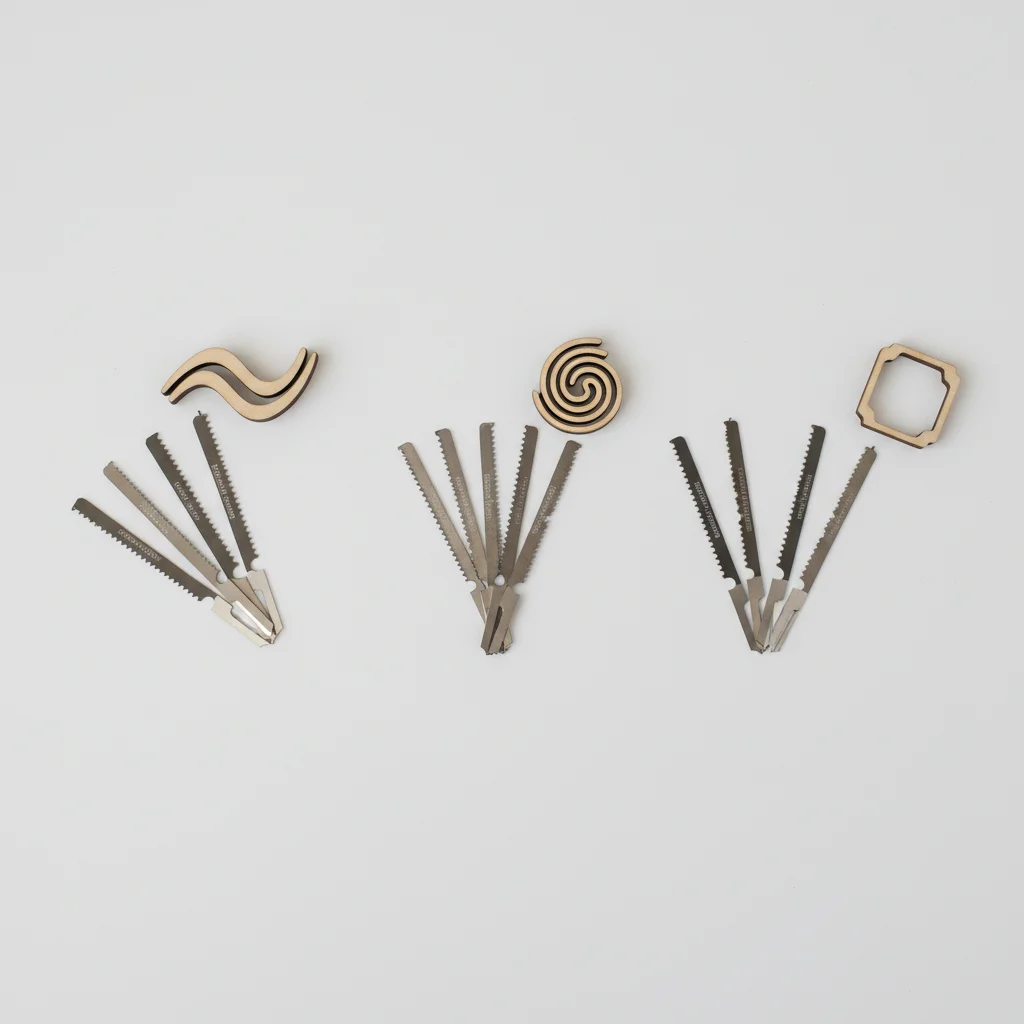
Choosing the right scroll saw blade tooth style is crucial for achieving smooth curves and intricate designs in your woodworking projects. For the cleanest, most precise curves, a reverse-tooth blade or a skip-tooth blade is generally recommended. These styles are specifically designed to minimize tear-out and provide a superior finish, especially when navigating tight turns and delicate patterns.
Understanding Reverse-Tooth Blades for Clean Curves
Reverse-tooth scroll saw blades feature a section of teeth at the bottom that are angled upwards, or in reverse. This unique design helps to prevent splintering and fuzzing on the underside of your workpiece, which is a common issue with standard blades, especially when cutting plywood or veneered materials. The upward-facing teeth effectively clean up the exit cut, leaving both the top and bottom surfaces exceptionally smooth. This makes them ideal for projects where both sides of the material will be visible, such as decorative inlays or intricate fretwork. For compare top scroll saws on this site.
When using reverse-tooth blades, you might notice a slightly slower cutting speed compared to standard blades due to the opposing tooth direction. However, the trade-off in speed is well worth the significantly improved finish, reducing the need for extensive sanding afterwards. They are particularly effective for cutting softer woods and composite materials where tear-out is a major concern.
The Benefits of Skip-Tooth Blades for Intricate Work
Skip-tooth blades are characterized by having a space between each tooth, rather than a continuous row. This design helps to prevent the blade from overheating and reduces the amount of sawdust buildup in the kerf, allowing for cooler and more efficient cutting. The larger gullets between the teeth also make these blades excellent for cutting thicker materials, as they provide ample space for chip evacuation. For intricate curves and detailed work, skip-tooth blades offer a good balance between cutting speed and finish quality.
While not as effective at preventing underside tear-out as reverse-tooth blades, skip-tooth blades still produce a very clean cut, especially on hardwoods. Their ability to cut cooler also extends blade life, making them a durable choice for various projects. They are a versatile option for woodworkers who frequently switch between different wood types and thicknesses, and they excel at navigating tight radii without binding.
Selecting the Right TPI for Your Curve Requirements
|
Our Picks for the Best Scroll Saw in 2026
As an Amazon Associate I earn from qualifying purchases.
|
||
| Num | Product | Action |
|---|---|---|
| 1 | BLACK+DECKER Jig Saw, 4.5 -Amp (BDEJS300C) |

|
| 2 | Big Book of Scroll Saw Woodworking: More Than 60 Projects and Techniques for Fretwork, Intarsia, and Other Scroll Saw Crafts (Fox Chapel Publishing) Patterns for Beginners to Advanced Woodworkers |
|
| 3 | Scrolling 101: Everything the Beginner Needs to Know (Fox Chapel Publishing) Scroll Saw Basics, Choosing Blades, Adapting Patterns, Using a Starter Saw, Sanding, and a Skill-Building Exercise Pattern |
|
| 4 | 3D Scroll Saw Projects: 35 Fun Compound-Cut Projects, More Than 150 Patterns (Fox Chapel Publishing) Scroll Saw Woodworking & Crafts Magazine Compilation - Ornaments, Home Décor, Chess Set, and More |
|
| 5 | Scroll Saw Workbook, 3rd Edition: Learn to Master Your Scroll Saw in 25 Skill-Building Chapters (Fox Chapel Publishing) Ultimate Beginner's Guide with Projects to Hone Your Scrolling Skills |
|
| 6 | 2025 Scroll saw patterns: Scroll saw patterns: Inspirations for wood lovers: 164 patterns with Trees of Life, Hearts, Sailboats, animal family puzzles, landscapes... |
|
| 7 | Shop Fox W1872 16" VS Scroll Saw with Foot Switch, LED, Miter Gauge, Rotary Shaft |
|
| 8 | Making Wooden People & Pets with Personality: 24 Easy Projects for the Scroll Saw (Fox Chapel Publishing) Full-Size Patterns for Beginners and Intermediate Scrollers to Create Handmade Gifts in Wood |
|
| 9 | WEN Adjustable Scroll Saw Stand for all WEN and DeWALT® Scroll Saws (MSA1621) |
|
| 10 | FOXBC 5-Inch Scroll Saw Blade Pin End Replacement for Wen 3921 3923, Dremel, Craftsman, Penn State, Delta, Ryobi and All 15in.and 16in.Scroll Saw For Wood, High Carbon Steel - 48 Pack |
|
Beyond tooth style, the Teeth Per Inch (TPI) of your scroll saw blade also plays a significant role in achieving smooth curves. Generally, a higher TPI (e.g., 12-18 TPI) will result in a smoother cut, as more teeth are engaging the material over a shorter distance. This is particularly important for delicate curves and fine details where precision is paramount. Conversely, lower TPI blades (e.g., 5-8 TPI) cut faster but leave a rougher edge, making them less suitable for projects requiring a pristine finish on curves.
For optimal results when cutting curves, consider a blade with a TPI that matches the thickness and density of your material. Thinner materials and softer woods benefit from higher TPI blades, while thicker, denser woods might require a slightly lower TPI to prevent excessive heat buildup and ensure efficient cutting, while still maintaining a good finish with the right tooth style.
Other Blade Styles and Their Curve Performance
While reverse-tooth and skip-tooth blades are top contenders for smooth curves, other blade styles have their place. Standard tooth blades, for instance, are general-purpose blades suitable for a wide range of cuts, but they may produce more tear-out on curves. Spiral blades, with their teeth all around the blade, allow for cutting in any direction without rotating the workpiece, which can be advantageous for extremely complex, multi-directional curves. However, they tend to leave a wider kerf and a rougher finish compared to flat blades.
- Standard Tooth Blades: Good for general cutting, but prone to tear-out on curves.
- Spiral Blades: Excellent for multi-directional cuts without turning the workpiece, but leave a rougher finish.
- Crown Tooth Blades: Designed for faster cutting and chip removal, but less ideal for ultra-smooth curves.
- Double Skip-Tooth Blades: Offer good chip clearance for thicker materials, with a slightly smoother finish than standard skip-tooth.
- Precision Ground Blades: Often have very sharp, precisely ground teeth for exceptionally clean and accurate cuts, ideal for fine detail.
Ultimately, the best tooth style for smooth curves depends on your specific project, the material you’re using, and the level of finish you desire. Experimenting with different blades will help you discover which ones yield the best results for your unique scroll saw work.Investing in a variety of blade types will equip you to tackle any intricate design with confidence and precision.

I usually stick to standard blades, but I picked up some skip-tooth blades for a project with really tight curves. They worked great for navigating those intricate designs without binding. I still prefer reverse-tooth for general work to avoid splintering, but for those super detailed pieces, the skip-tooth style really shines. Good to have both in the toolbox.
I tried the reverse-tooth blades hoping to eliminate all tear-out on my veneered wood, but I still got a little bit, especially on very thin pieces. It was definitely better than my old blades, but not a complete miracle worker for every material. I think I need to adjust my feed rate more, but I was hoping for a bit more of a perfect finish right out of the gate.
For anyone doing intarsia or marquetry, the advice on reverse-tooth blades is spot on. I used to spend so much time sanding the back of my pieces. Now, with these blades, the top and bottom surfaces are consistently smooth, which saves me a ton of time and effort. It’s made my intricate designs look much more professional.
I’ve been struggling with tear-out on the underside of my plywood projects for ages, and I finally decided to try the reverse-tooth blades after reading about them. What a difference! My cuts are so much cleaner now, especially on delicate patterns. It really does make the exit cut incredibly smooth, just like it said. Definitely a game changer for my scroll saw work.