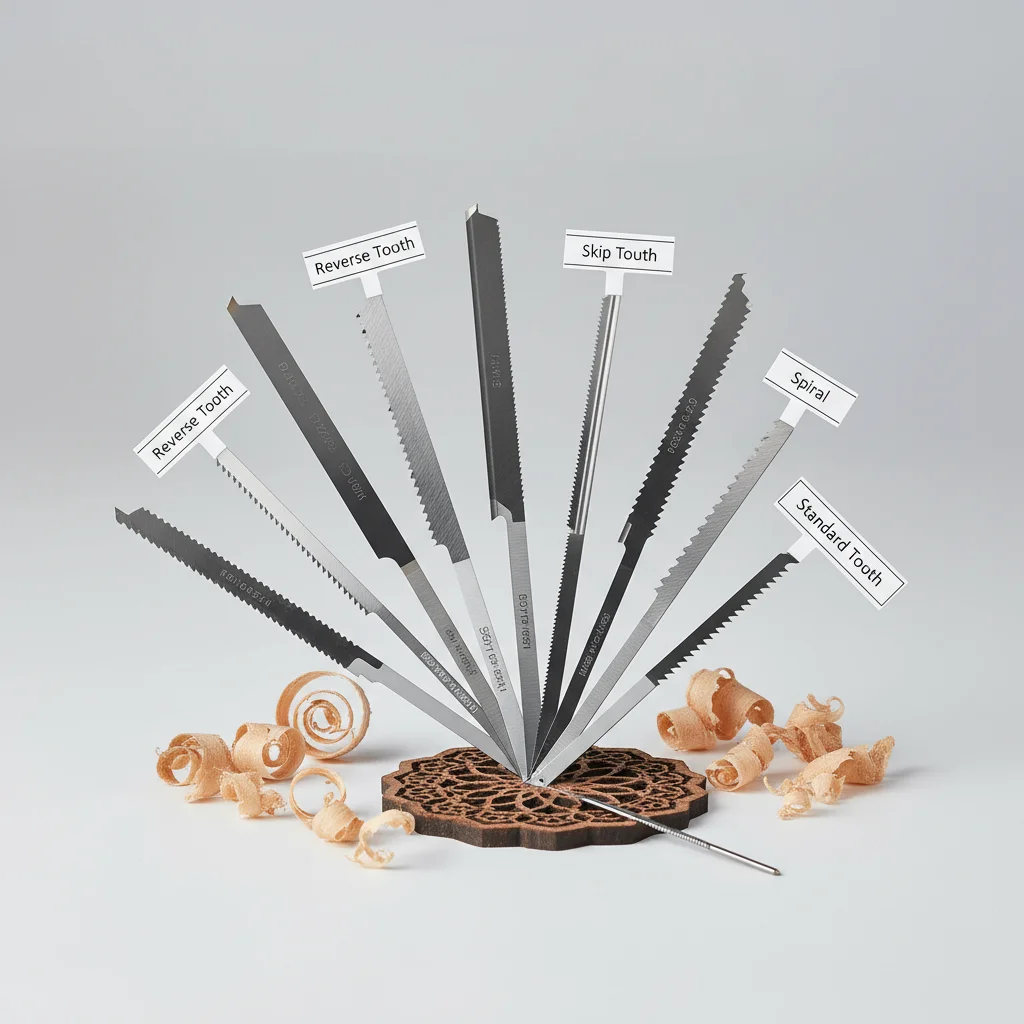
Choosing the right scroll saw blade is crucial for achieving clean, intricate cuts in your woodworking and crafting projects. For the most detailed and delicate work, a #2 reverse-tooth blade is often considered the best option, offering a balance of fine cutting and reduced tear-out on the underside of your material. However, the ‘best’ blade ultimately depends on the material you’re cutting, the desired finish, and the complexity of your design.
Understanding Scroll Saw Blade Types
Scroll saw blades come in a wide variety of types, each designed for specific applications. Standard tooth blades are general-purpose and good for most woods. Skip-tooth blades have wider gaps between teeth, which helps prevent burning and allows for faster cutting, especially in thicker materials. Reverse-tooth blades, as mentioned, have a few teeth at the bottom pointing upwards, which helps to minimize tear-out on the back of your workpiece, resulting in a cleaner finish.
Beyond these common types, you’ll also find spiral blades, which cut in all directions without needing to rotate the workpiece, ideal for extremely complex internal cuts. Crown tooth blades are excellent for plastics and soft metals, while two-way cut blades cut on both the up and down stroke, speeding up the process. Selecting the correct blade size, indicated by a number (e.g., #2, #5, #9), is also vital, with smaller numbers indicating finer blades for more delicate work.
Matching Blades to Materials
The material you’re cutting dictates the optimal blade choice. For hardwoods like oak or maple, a skip-tooth or reverse-tooth blade with a smaller number (e.g., #3 or #5) will provide a good balance of cutting speed and finish quality. Softer woods such as pine or basswood can often be cut with slightly larger blades, like a #7 or #9, especially if intricate detail isn’t the absolute priority. When working with plastics, a crown tooth or a very fine skip-tooth blade is recommended to prevent melting and achieve a smooth edge. Metals, though less common for scroll saws, require specialized metal-cutting blades, typically very fine and often made from hardened steel.
Achieving Precision and Smooth Finishes
|
Our Picks for the Best Scroll Saw in 2026
As an Amazon Associate I earn from qualifying purchases.
|
||
| Num | Product | Action |
|---|---|---|
| 1 | Shop Fox W1872 16" VS Scroll Saw with Foot Switch, LED, Miter Gauge, Rotary Shaft |

|
| 2 | 2025 Scroll saw patterns: Scroll saw patterns: Inspirations for wood lovers: 164 patterns with Trees of Life, Hearts, Sailboats, animal family puzzles, landscapes... |
|
| 3 | Big Book of Scroll Saw Woodworking: More Than 60 Projects and Techniques for Fretwork, Intarsia, and Other Scroll Saw Crafts (Fox Chapel Publishing) Patterns for Beginners to Advanced Woodworkers |
|
| 4 | FOXBC 5-Inch Scroll Saw Blade Pin End Replacement for Wen 3921 3923, Dremel, Craftsman, Penn State, Delta, Ryobi and All 15in.and 16in.Scroll Saw For Wood, High Carbon Steel - 48 Pack |
|
| 5 | Making Wooden People & Pets with Personality: 24 Easy Projects for the Scroll Saw (Fox Chapel Publishing) Full-Size Patterns for Beginners and Intermediate Scrollers to Create Handmade Gifts in Wood |
|
| 6 | Scroll Saw Workbook, 3rd Edition: Learn to Master Your Scroll Saw in 25 Skill-Building Chapters (Fox Chapel Publishing) Ultimate Beginner's Guide with Projects to Hone Your Scrolling Skills |
|
| 7 | Scrolling 101: Everything the Beginner Needs to Know (Fox Chapel Publishing) Scroll Saw Basics, Choosing Blades, Adapting Patterns, Using a Starter Saw, Sanding, and a Skill-Building Exercise Pattern |
|
| 8 | WEN Adjustable Scroll Saw Stand for all WEN and DeWALT® Scroll Saws (MSA1621) |
|
| 9 | BLACK+DECKER Jig Saw, 4.5 -Amp (BDEJS300C) |
|
| 10 | 3D Scroll Saw Projects: 35 Fun Compound-Cut Projects, More Than 150 Patterns (Fox Chapel Publishing) Scroll Saw Woodworking & Crafts Magazine Compilation - Ornaments, Home Décor, Chess Set, and More |
|
Precision in scroll saw work is not just about the blade, but also about technique. Always let the blade do the work; forcing the material can lead to blade breakage, burning, and inaccurate cuts. For the smoothest finishes, especially on delicate projects, consider using a very fine blade (e.g., #0 or #1) and a slower speed setting on your scroll saw. This reduces friction and heat, minimizing tear-out and leaving a cleaner edge that requires less sanding. Regular cleaning of your blade can also extend its life and maintain cutting efficiency.
- Always use the finest blade possible for the desired intricacy.
- Match blade type to the material being cut (wood, plastic, metal).
- Ensure proper blade tension to prevent breakage and improve cut quality.
- Consider reverse-tooth blades for minimal tear-out on delicate pieces.
- Experiment with different blade sizes and types to find your preferred combination.
Blade Tension and Speed Settings
Correct blade tension is paramount for effective scroll saw operation. A blade that is too loose will vibrate excessively, leading to rough cuts and increased blade breakage. A blade that is too tight can also break prematurely and put undue stress on your scroll saw’s motor. A good rule of thumb is to pluck the blade; it should produce a clear, high-pitched ‘ping’ sound. Most scroll saws also feature variable speed controls. Slower speeds are generally better for intricate cuts, harder materials, and preventing burning, while faster speeds can be used for less detailed work in softer materials. Always consult your scroll saw’s manual for recommended tension and speed settings for various blade types and materials.
For a wide selection of high-quality scroll saw blades, check out. They offer a variety of brands and types to suit every project need. And if you’re looking to upgrade your scroll saw for even better blade compatibility and performance, consider browsing the latest models at.
