The best compact scroll saws for small shops in 2026 offer powerful performance and precision without demanding a large footprint, transforming even the smallest corner into a productive creative hub. For woodworkers and crafters with limited space, selecting a compact scroll saw is crucial for intricate cuts and delicate designs. This guide examines top models like the SKIL 1.2 Amp 16-inch and the Dremel MS20-01 Moto-Saw, highlighting features that maximize potential in small workshops.
What is a Scroll Saw? (Definition and Applications)
A scroll saw is a specialized power tool characterized by its thin, reciprocating blade, designed for cutting intricate curves, delicate patterns, and elaborate internal cutouts in various materials. Unlike a band saw, which uses a continuous loop blade, a scroll saw’s blade moves rapidly up and down, much like a sewing machine needle. This unique action allows for exceptional precision and the ability to pivot the workpiece around the blade, creating designs that other saws simply cannot achieve.
Scroll saws are highly versatile and find extensive use in numerous creative and practical applications. They are perfect for detailed woodworking projects such as fretwork, where ornamental designs with delicate cut-outs are created, and marquetry, involving decorative veneer work [cite: 1 (features)]. Crafters also use them for making custom name plaques, signs, and especially for creating complex puzzles and layered 3D toys. From fine art to functional items, a compact scroll saw empowers artisans to bring their most detailed visions to life, even in the tightest of spaces [cite: 1 (features)]. For scroll saws buying guides on this site.
Types of Scroll Saws for Small Workshops
When space is at a premium, understanding the different types of scroll saws available helps you choose one that fits both your needs and your workshop’s physical constraints. For small shops, the focus is primarily on benchtop models and highly portable options.
Benchtop/Compact Scroll Saws
Benchtop scroll saws are the most common and practical choice for small workshops. These machines are designed to sit on a workbench or a dedicated stand, offering a balance between cutting capacity and footprint. Modern compact benchtop models often incorporate advanced engineering to maximize cutting capacity while minimizing their physical presence, with many models weighing less than 30 pounds. They are typically characterized by throat depths ranging from 12 to 16 inches, which is sufficient for most intricate hobby and craft projects. These saws are ideal for apartment workshops, shared spaces, or dedicated craft rooms where every square inch matters.
Highly Portable/Handheld Scroll Saws
For those with extremely limited space or a need for mobility, highly portable or handheld scroll saws offer a unique solution. The Dremel MS20-01 Moto-Saw, for example, is notable for its compact C-arm design and ability to be used as both a stationary, clamped-on saw and a handheld coping saw. Weighing as little as 2.4 pounds, these tools are designed for small workpieces and quick, precision cuts, making them excellent for on-the-go projects or for crafters who need to stow their tools away completely after use. While they might have limitations in terms of surface area for larger projects, their unparalleled portability is a significant advantage for very small or transient workspaces.
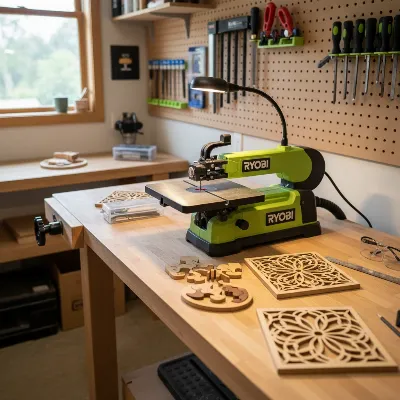 A compact scroll saw being used in a small, organized workshop with various intricate woodworking projects displayed
Anatomy and Working Principle of a Compact Scroll Saw
Understanding the core components and how a scroll saw operates demystifies the tool and helps users appreciate its precision capabilities.
Key Components of a Compact Scroll Saw
|
Our Picks for the Best Scroll Saw in 2026
As an Amazon Associate I earn from qualifying purchases.
|
||
| Num | Product | Action |
|---|---|---|
| 1 | Shop Fox W1872 16" VS Scroll Saw with Foot Switch, LED, Miter Gauge, Rotary Shaft |

|
| 2 | FOXBC 5-Inch Scroll Saw Blade Pin End Replacement for Wen 3921 3923, Dremel, Craftsman, Penn State, Delta, Ryobi and All 15in.and 16in.Scroll Saw For Wood, High Carbon Steel - 48 Pack |
|
| 3 | Big Book of Scroll Saw Woodworking: More Than 60 Projects and Techniques for Fretwork, Intarsia, and Other Scroll Saw Crafts (Fox Chapel Publishing) Patterns for Beginners to Advanced Woodworkers |
|
| 4 | Scrolling 101: Everything the Beginner Needs to Know (Fox Chapel Publishing) Scroll Saw Basics, Choosing Blades, Adapting Patterns, Using a Starter Saw, Sanding, and a Skill-Building Exercise Pattern |
|
| 5 | Scroll Saw Workbook, 3rd Edition: Learn to Master Your Scroll Saw in 25 Skill-Building Chapters (Fox Chapel Publishing) Ultimate Beginner's Guide with Projects to Hone Your Scrolling Skills |
|
| 6 | BLACK+DECKER Jig Saw, 4.5 -Amp (BDEJS300C) |
|
| 7 | Making Wooden People & Pets with Personality: 24 Easy Projects for the Scroll Saw (Fox Chapel Publishing) Full-Size Patterns for Beginners and Intermediate Scrollers to Create Handmade Gifts in Wood |
|
| 8 | 3D Scroll Saw Projects: 35 Fun Compound-Cut Projects, More Than 150 Patterns (Fox Chapel Publishing) Scroll Saw Woodworking & Crafts Magazine Compilation - Ornaments, Home Décor, Chess Set, and More |
|
| 9 | 2025 Scroll saw patterns: Scroll saw patterns: Inspirations for wood lovers: 164 patterns with Trees of Life, Hearts, Sailboats, animal family puzzles, landscapes... |
|
| 10 | WEN Adjustable Scroll Saw Stand for all WEN and DeWALT® Scroll Saws (MSA1621) |
|
A compact scroll saw, despite its smaller size, features the essential components found in larger models, optimized for efficiency and space.
- Blade: The heart of the scroll saw, these thin blades are available in various tooth configurations for different materials (wood, plastic, thin metal) and levels of intricacy. They can be pinned (with small pins at each end for quick attachment) or pinless (held by small clamps, offering a wider range of blade types for finer work) [cite: 3 (features)].
- Table: The flat surface where the workpiece rests. Most tables tilt, allowing for angled or bevel cuts, with some models offering up to 45-degree tilt to either side [cite: 4 (features), search 5 (features)]. Cast aluminum or cast iron tables are common, with cast iron providing better vibration damping [cite: 2, search 4].
- Motor: Provides the power for the blade’s reciprocating action. For compact saws, motors typically range from 1.2 to 1.6 amps, sufficient for cutting through hardwoods up to 2 inches thick [cite: 1, search 4 (features)].
- Arms: Most scroll saws feature a parallel arm or double parallel-link arm design. The latter, seen in saws like the DEWALT DW788, significantly reduces vibration and noise, leading to smoother, more accurate cuts [cite: 2, search 4 (features)]. The arms hold and move the blade.
- Controls: Essential controls include an on/off switch, variable speed control (often a knob or foot pedal), and blade tension adjustment. Front-mounted controls are highly desirable for accessibility and safety [cite: 2 (beginners), search 4 (features)].
- Dust Management System: Many compact saws include an integrated dust blower to clear sawdust from the cutting line, and some have a dust port for vacuum attachment, keeping the workspace cleaner and improving visibility [cite: 1, search 4].
- Work Light: Integrated LED lights are a common feature, providing direct illumination on the workpiece for enhanced visibility and precision [cite: 1, search 4].
Basic Working Principle of a Scroll Saw
The fundamental principle behind a scroll saw’s operation is straightforward yet highly effective for detailed work. The motor drives a mechanism that causes the blade to move rapidly up and down (reciprocate) through a small opening in the table. The workpiece is manually guided against the blade, allowing the user to follow intricate patterns.
The variable speed control allows the user to adjust the strokes per minute (SPM), typically ranging from 400 to 1,750 SPM [cite: 4 (features), search 5]. Slower speeds are ideal for delicate cuts, harder materials, or beginners, offering greater control and reducing blade breakage. Faster speeds are suitable for softer woods and quicker cuts. For internal cuts, a small hole is drilled in the workpiece, the blade is detached from the upper arm, fed through the hole, and then reattached and tensioned, enabling precise cutouts within the material without cutting from the edge [cite: 2 (features), search 3 (features)]. The ability to make such intricate cuts is what sets the scroll saw apart in the woodworking world.
Top Compact Scroll Saws for Small Shops in 2026
Choosing the best compact scroll saw means finding a tool that balances footprint with performance, making it suitable for limited spaces without compromising on precision or versatility. Based on independent research and aggregated customer feedback, here are some of the top compact scroll saws highly regarded for small workshops in 2026.
| Model | Throat Depth | Speed Range (SPM) | Blade Type | Weight (approx.) | Special Features | Pros for Small Shops | Cons for Small Shops |
|---|---|---|---|---|---|---|---|
| SKIL 1.2 Amp 16-inch Variable Speed Scroll Saw | 16 inches | Variable (e.g., 500-1700) | Pinned & Pinless | 24.7 lbs | LED Work Light, Foot Pedal Control, Electronic Variable Speed | Excellent for beginners, compact, hands-free operation [cite: 1, search 2, search 4] | Might lack power for very dense hardwoods. |
| RYOBI 1.2 Amp 16-inch Scroll Saw | 16 inches | Variable | Pinned & Pinless | 27.1 lbs | Cast Aluminum Table, Integrated Dust Collection, Tool-free Blade Change | Good balance of stability & portability, versatile blade use [cite: 1, search 2] | Base may require initial adjustment [cite: 5 (2025 version)] |
| Dremel MS20-01 Moto-Saw | 9.8 inches | Variable (1,500-2,250) | Pinless (specialized) | 2.4 lbs | Handheld/Benchtop convertible, Compact C-Arm Design, Hard Case | Extremely portable, smallest footprint, versatile for small projects [cite: 2, search 5] | Limited surface area for larger projects, smaller throat depth |
| WEN 3921 16-inch Variable Speed Scroll Saw | 16 inches | Variable (550-1600) | Pinned & Pinless | 38 lbs | Two-Direction Blade, Cast Iron Base, Air Pump, Dust Port | Affordable, dual blade direction for infinite ripping, reduced vibration [cite: 2, search 3, search 4] | Can be noisy and vibrate at higher speeds without secure mounting |
| DEWALT DW788 20-inch Variable Speed Scroll Saw | 20 inches | Variable (400-1750) | Pinless (tool-free) | 56 lbs | Double Parallel-Link Arm, Tool-Free Blade Clamps, Low Vibration | Professional performance, extremely smooth operation, precise cuts [cite: 2, search 3] | Larger footprint and heavier, higher price point, less “compact” |
The SKIL 1.2 Amp 16-inch Variable Speed Scroll Saw is consistently highlighted as an excellent value, particularly for beginners in compact settings [cite: 1, search 2]. Its LED light, foot pedal control, and variable speed make it user-friendly, allowing both hands to remain on the workpiece for improved precision and safety.
The RYOBI 1.2 Amp 16-inch model offers a strong balance of features for its size, with a sturdy cast aluminum table and an integrated dust collection system. Its ability to use both pinned and pin-end blades provides flexibility for various cutting applications.
For ultimate portability and minimal footprint, the Dremel MS20-01 Moto-Saw stands out. It’s a unique tool that can quickly convert from a benchtop scroll saw to a handheld coping saw, making it incredibly versatile for extremely small projects or when space is severely constrained [cite: 2, search 5].
The WEN 3921 offers robust features at a budget-friendly price point. Its ability to accept blades in two directions (standard and 90 degrees) provides “infinite ripping capacity,” a significant advantage for small shops needing to cut wider pieces.
While often considered a premium, full-sized option, the DEWALT DW788 is frequently recommended for its exceptional low vibration and smooth operation, which are valuable qualities even in a smaller shop if the space can accommodate its 20-inch throat depth and heavier build [cite: 2, search 3]. It’s often cited as the “best overall choice” even for beginners, due to its reliable performance and durability [cite: 1 (beginners)].
Choosing the Right Compact Scroll Saw for Your Small Shop (Buying Guide)
Selecting the ideal compact scroll saw involves weighing several factors unique to small workshops. It’s about finding a tool that fits your physical space, skill level, and project ambitions without overspending or compromising on essential features.
Key Factors to Consider
- Footprint and Weight: This is paramount for a small shop. Look for models with a compact base that can fit on your existing workbench. Lighter saws (under 30-40 lbs) are easier to move and store, which is crucial if you need to clear your workspace regularly [cite: 1, search 3 (features)]. A sturdy, balanced design will also prevent it from “walking” on the bench due to vibration [cite: 3 (features)].
- Vibration: Less vibration means more precise cuts and a more comfortable user experience. Double parallel-link arm designs are excellent for minimizing vibration [cite: 2, search 4 (features)]. While some vibration is normal, excessive shaking can lead to inaccurate cuts and user fatigue [cite: 3 (features)].
- Variable Speed Control: Essential for working with different materials and achieving fine details. A wide speed range allows you to slow down for intricate cuts and harder materials, and speed up for softer woods [cite: 1 (beginners), search 4 (features)].
- Blade Changing System: For intricate fretwork, you’ll be changing blades frequently for internal cuts. Look for tool-free blade clamps or quick-release mechanisms. The ability to use both pinned and pinless blades offers greater versatility, as pinless blades are available in finer sizes for precision [cite: 1 (beginners), search 3 (features)].
- Throat Depth: This determines the maximum width of a workpiece you can cut (from the blade to the back of the arm). For most small shop projects, a 16-inch throat depth is sufficient, though 18-inch or 20-inch offers more capacity if your space allows [cite: 1, search 4 (features)].
- Table Tilt: A tilting table (or tilting arm) is necessary for making bevel cuts. Ensure it’s easy to adjust and offers the tilt angles you anticipate needing (e.g., up to 45 degrees) [cite: 4 (features)].
- Dust Management: An integrated dust blower helps keep your cutting line visible. A dust port for connecting a shop vacuum is a bonus, keeping your small shop cleaner and reducing airborne dust [cite: 1, search 4 (features)].
- Work Light: An integrated LED work light significantly improves visibility, especially for detailed work, reducing eye strain [cite: 1, search 4].
- Budget: Set a realistic budget early. While high-end saws offer superior features, excellent compact options are available across various price points [cite: 3 (features)].
Scroll Saw for Beginners in Small Shops
For those just starting out in a small workshop, prioritize ease of use, safety, and a manageable learning curve.
- User-Friendly Controls: Easily accessible on/off switches, speed controls, and blade tension adjustments are crucial [cite: 2 (beginners), search 4 (features)].
- Safety Features: A foot pedal for hands-free speed control or a readily accessible power switch enhances safety by allowing quick shutdowns and keeping hands on the workpiece [cite: 1, search 4 (features)].
- Good Visibility: An integrated work light and a dust blower are highly beneficial for maintaining a clear view of your cut line [cite: 1, search 4].
- Affordable: Starting with a budget-friendly model like the SKIL 16-inch or WEN 16-inch allows you to develop skills without a large initial investment [cite: 1 (beginners), search 3 (beginners)].
Scroll Saw for Experienced Crafters/Professionals in Small Shops
Experienced users will look for precision, durability, and advanced features to tackle more complex projects efficiently.
- Superior Vibration Control: A saw with minimal vibration, like those with double parallel-link arms, provides exceptional accuracy for intricate work and longer use.
- Robust Construction: A heavier cast-iron base offers better stability and durability, even if it adds to the overall weight [cite: 2, search 4].
- Advanced Blade System: A tool-free pinless blade changing system is often preferred for rapid, precise internal cuts and access to a wider variety of specialized blades [cite: 1 (beginners), search 3 (features)].
- Power and Reliability: While scroll saws aren’t high-horsepower tools, consistent power delivery is important for cutting through denser hardwoods smoothly.
- Ergonomics: Comfort features, like a well-designed table and accessible controls, become more important during extended work sessions.
“In a small shop, every tool must earn its space. A compact scroll saw isn’t just about saving room; it’s about maximizing efficiency and allowing for detailed work that bigger tools simply can’t handle.” – Johnathan Reed, Founder of ReviewByJoh.com
Using and Maintaining Your Compact Scroll Saw
Proper usage and regular maintenance are vital for getting the best performance from your compact scroll saw and extending its lifespan, especially in a small shop where tools are often heavily relied upon.
Steps to Prepare Before Using Your Scroll Saw
- Secure Mounting: Ensure your scroll saw is securely clamped or bolted to a stable workbench. This minimizes vibration and prevents the saw from “walking” during operation, which is crucial for precision and safety, particularly with lighter compact models [cite: 3 (features)].
- Blade Selection and Installation: Choose the appropriate blade for your material and cut intricacy. Install the blade correctly, ensuring the teeth point downwards and forwards. For internal cuts, thread the blade through a pre-drilled pilot hole in your workpiece before clamping the top [cite: 2 (features), search 5 (features)].
- Blade Tension Adjustment: Proper blade tension is critical. Too loose, and the blade will twist or wander, leading to inaccurate cuts. Too tight, and it risks breaking, especially thinner blades [cite: 3 (features)]. Most saws have a tension knob or lever; adjust it until the blade produces a clear “ping” when plucked. It’s recommended to release blade tension when the saw is not in use to prolong blade life and prevent fatigue on the saw’s components [cite: 3 (features)].
- Table Tilt: Adjust the table angle if you plan to make bevel cuts. Ensure it’s locked securely at the desired angle [cite: 4 (features)].
- Safety Gear: Always wear eye protection, a dust mask or respirator, and hearing protection [cite: 2 (features)]. Small wood fragments and sawdust are common, and prolonged noise exposure can be damaging.
Basic and Advanced Cutting Techniques with a Scroll Saw
- Basic Cuts: Approach the blade slowly and guide the workpiece steadily. Let the blade do the work; avoid forcing the material, which can cause blade deflection or breakage. Use a light touch and maintain constant contact with the table.
- Following Lines: For intricate patterns, guide the workpiece slowly, allowing the blade to remove material along the line. Use both hands to control the piece, especially on smaller parts.
- Tight Curves: When making tight curves, ease into the turn, sometimes backing out slightly to relieve tension on the blade. You can “pivot cut” by holding the workpiece stationary and letting the blade cut a small amount, then slightly turning the piece and repeating, or use spiral blades which cut in any direction without turning the workpiece [cite: 2 (features)].
- Fretwork and Internal Cuts: For internal cutouts, after drilling a pilot hole and threading the blade, ensure precise control. Take your time, especially on corners.
- Stack Cutting: For multiple identical pieces, tape or glue several layers of thin material together, then cut them simultaneously. This is efficient but requires good blade tension and a steady hand.
Safety Measures When Using a Scroll Saw
While scroll saws are generally considered safer than many other power saws, vigilance is key:
- Keep Fingers Away: Always keep your fingers to the side or back of the blade, especially when working with small pieces [cite: 2 (features)]. Use a push stick for very small work.
- Clear Workspace: Maintain a clear work area around the saw to prevent accidents from clutter.
- Unplug When Changing Blades/Adjusting: Always unplug the saw before changing blades, making adjustments, or performing maintenance to prevent accidental activation.
- Check Workpiece: Ensure your workpiece is free of nails, screws, or other obstructions that could damage the blade or cause kickback.
Maintenance and Cleaning Tips for Scroll Saw Longevity
Regular care ensures your scroll saw performs optimally and lasts for years:
- Clean After Each Use: Clear sawdust and debris from the table, blade area, and motor vents. A dust blower or shop vacuum is effective. Built-up sawdust can impede performance and cause overheating.
- Inspect Blades: Check blades for dullness, bends, or missing teeth. Replace dull blades promptly for cleaner cuts and to reduce strain on the motor.
- Release Blade Tension: As mentioned, release blade tension when the saw is not in use to prevent stress on the upper and lower arms and to prolong blade life [cite: 3 (features)].
- Lubrication: Consult your owner’s manual for any recommended lubrication points. Avoid over-lubrication, which can attract dust.
- Store Properly: When not in use, store your scroll saw in a clean, dry area, ideally covered, to protect it from dust and humidity. If it’s a portable model, store it in its case.
 A close-up of hands carefully changing a scroll saw blade, with safety glasses visible
Common Issues and Troubleshooting When Using a Compact Scroll Saw
Even the most reliable compact scroll saws can encounter issues. Knowing how to identify and address common problems can save you time and frustration, keeping your projects on track.
- Blade Breakage: This is a very common issue.
- Cause: Too much tension, forcing the workpiece, dull blade, using the wrong blade for the material, or excessive vibration.
- Fix: Ensure correct blade tension (a clear “ping” when plucked), let the blade cut at its own pace, use sharp blades, select the appropriate blade type and size for your material, and minimize vibration by securing the saw.
- Excessive Vibration:
- Cause: Saw not securely mounted, loose components, unbalanced motor, or internal issues.
- Fix: First, check if the saw is tightly clamped or bolted to a sturdy, flat surface [cite: 3 (features)]. Inspect the saw for any loose screws or parts. If the problem persists, it might indicate an internal motor or mechanism issue that requires professional attention.
- Inaccurate or Rough Cuts:
- Cause: Dull blade, incorrect blade tension, forcing the workpiece, blade deflection, or an unstable table.
- Fix: Replace dull blades. Adjust blade tension. Guide the workpiece gently and consistently. Ensure your table is clean and free of debris, and that the workpiece is fully supported.
- Motor Overheating/Stalling:
- Cause: Overworking the motor (e.g., cutting too thick/hard material, forcing cuts), blocked motor vents, or a faulty motor.
- Fix: Reduce the cutting speed and avoid forcing the material. Ensure motor vents are clear for proper cooling. If the motor repeatedly overheats or stalls under normal load, it may need servicing.
- Dust Buildup Obscuring Cut Line:
- Cause: Ineffective or blocked dust blower, lack of a dust collection system.
- Fix: Clean the dust blower nozzle. Ensure the dust port (if available) is connected to a vacuum. Regularly clean the table surface to prevent accumulation.
- Blade Drifting (not cutting straight):
- Cause: Incorrect blade tension, dull blade, warped workpiece, or inconsistent feeding.
- Fix: Re-tension the blade, replace if dull. Ensure the workpiece is flat and guide it smoothly along the intended line.
When troubleshooting, always refer to your scroll saw’s owner’s manual first, as it often provides specific guidance for your model. For complex issues or if you’re uncomfortable performing a repair, it’s always best to take your scroll saw to an authorized service center to prevent further damage or injury.
Conclusion
For the dedicated craftsman or hobbyist operating within the confines of a small shop, a compact scroll saw is not merely a convenience but a necessity. The right model empowers you to tackle intricate designs and delicate projects with precision, without monopolizing valuable workspace. From the beginner-friendly SKIL with its foot pedal control to the ultra-portable Dremel Moto-Saw, and the robust, low-vibration DEWALT, the market offers exceptional options tailored for small-shop environments in 2026. Prioritizing features like variable speed, easy blade changes, low vibration, and efficient dust management will ensure your chosen scroll saw serves as a reliable, long-lasting partner in your creative endeavors. Investing in a compact scroll saw means investing in expanded possibilities, proving that even the smallest space can yield the most magnificent creations.
What intricate project will you bring to life with your new compact scroll saw?
Frequently Asked Questions
What is the ideal throat depth for a compact scroll saw in a small workshop?
For most compact scroll saws used in small workshops, a throat depth of 16 inches offers a versatile balance. It provides ample capacity for intricate designs, puzzles, and most craft projects, allowing sufficient room to maneuver your workpiece without requiring an excessively large machine footprint.
How important is variable speed control on a compact scroll saw?
Variable speed control is highly important on a compact scroll saw, as it allows you to adjust the blade’s strokes per minute (SPM) to match the material and intricacy of your cut. Slower speeds are better for delicate work, harder woods, or when starting out, while faster speeds suit softer materials and quicker cuts, preventing burning and ensuring cleaner results.
Can compact scroll saws handle hardwoods effectively?
Yes, many compact scroll saws are designed to handle hardwoods effectively, especially models with a 1.2 Amp motor or higher. The key is using the correct blade type for hardwoods and employing variable speed control to cut at a slower, controlled pace. Avoid forcing the material to prevent blade breakage and motor strain.
What maintenance is essential for a compact scroll saw?
Essential maintenance for a compact scroll saw includes cleaning sawdust after each use, inspecting and replacing dull blades, and releasing blade tension when the saw is not in use. This routine care prevents debris buildup, ensures optimal cutting performance, and prolongs the lifespan of your machine’s components.
Are there specific safety considerations for using a scroll saw in a small space?
In a small space, secure mounting of your scroll saw is paramount to minimize vibration and ensure stability. Always wear eye protection, a dust mask, and hearing protection. Keep your fingers away from the blade, and ensure your workspace is clear of clutter to prevent accidents in tight quarters.
Frequently Asked Questions
What is the ideal throat depth for a compact scroll saw in a small workshop?
For most compact scroll saws used in small workshops, a throat depth of 16 inches offers a versatile balance. It provides ample capacity for intricate designs, puzzles, and most craft projects, allowing sufficient room to maneuver your workpiece without requiring an excessively large machine footprint.
How important is variable speed control on a compact scroll saw?
Variable speed control is highly important on a compact scroll saw, as it allows you to adjust the blade's strokes per minute (SPM) to match the material and intricacy of your cut. Slower speeds are better for delicate work, harder woods, or when starting out, while faster speeds suit softer materials and quicker cuts, preventing burning and ensuring cleaner results.
Can compact scroll saws handle hardwoods effectively?
Yes, many compact scroll saws are designed to handle hardwoods effectively, especially models with a 1.2 Amp motor or higher. The key is using the correct blade type for hardwoods and employing variable speed control to cut at a slower, controlled pace. Avoid forcing the material to prevent blade breakage and motor strain.
What maintenance is essential for a compact scroll saw?
Essential maintenance for a compact scroll saw includes cleaning sawdust after each use, inspecting and replacing dull blades, and releasing blade tension when the saw is not in use. This routine care prevents debris buildup, ensures optimal cutting performance, and prolongs the lifespan of your machine's components.
Are there specific safety considerations for using a scroll saw in a small space?
In a small space, secure mounting of your scroll saw is paramount to minimize vibration and ensure stability. Always wear eye protection, a dust mask, and hearing protection. Keep your fingers away from the blade, and ensure your workspace is clear of clutter to prevent accidents in tight quarters.

I was hoping for a bit more oomph from a compact saw. While it’s true that these models save space, I found that some of the more delicate patterns I tried to cut felt a little underpowered. It works well for basic shapes, but if you’re doing really elaborate internal cutouts, you might need to take it slow. Still, it’s a decent option for a small workshop.
The Dremel MS20-01 Moto-Saw is a solid little machine for hobbyists. I appreciate how portable it is, making it easy to store away when I’m not using it. My only minor complaint is that changing the blades can be a bit fiddly compared to some larger models, but once you get the hang of it, it’s fine. Great for smaller craft projects and delicate designs.
As a woodworker with a tiny corner in my basement, finding a scroll saw that didn’t feel like a compromise was tough. This guide really helped me narrow down the options. The focus on maximizing potential in small workshops was spot on. I ended up getting one of the recommended models and it’s transformed my creative hub.
I’ve been looking for a scroll saw that wouldn’t take over my entire garage, and the SKIL 1.2 Amp 16-inch mentioned here is a game-changer. It fits perfectly on my workbench and still delivers plenty of power for the detailed work I do. The precision for intricate cuts is fantastic, even on thicker woods. Definitely recommend it for anyone with limited space.